

Categories
Featured

Kana Takahashi Of MindNation: Building A World Where Mental Health Is Valued, Accepted, And Supported

In 2014, Kana Takahashi was a bright-eyed pre-med student taking up Psychology at one of the Philippines’ top universities when one of her professors started talking to the class about mental health. “Back then, I didn’t know much about mental health,” she explains. “So when I heard my teacher talking about it, I got really curious.”

This curiosity led her to join the Youth For Mental Health Coalition — the only mental health organization in the Philippines at that time — and it was here that Kana became aware about the state of mental health in the country and the stigma faced by people with mental health concerns. Up until 2018, she immersed herself in advocacy work, learning not only about mental health but also about other causes like feminism and human rights.  From attending seminars, she was soon conducting them herself; additionally, she became involved in groups that pushed for laws like the Safe Spaces Act (which increases protection against sexual harassment, among others), the bill legalizing divorce (which is still currently being deliberated in Congress), and the Philippine Comprehensive Mental Health Law (which was signed into law last June 2018).

Along the way,  Kana started to reconsider her plans of becoming a doctor. “I started to ask myself why I wanted to become a doctor, and the answer I came up with was that I wanted to help people. And I realized that what I wanted was to help people now, not after four to five years of medical school.” With that in mind, Kana decided to just look for work that could sustain her financially and at the same time continue her advocacy work with the organizations she was currently affiliated with.

“I started to ask myself why I wanted to become a doctor, and the answer I came up with was that I wanted to help people. And I realized that what I wanted was to help people now, not after four to five years of medical school.”

Kana Takahashi, MindNation Co-Founder and CEO

The birth of MindNation

Along with some friends, Kana co-founded MindNation in January 2020, with the initial goal of providing mental health services for organizations, as mandated by the Philippine Mental Health Law. The company started with just four people (including Kana) and one psychologist.

But in March 2020, just three months after the company launched, the World Health Organization declared COVID-19 a pandemic. Many businesses coped with lockdown measures by cutting down on expenses — including putting all talks with MindNation on the back burner.

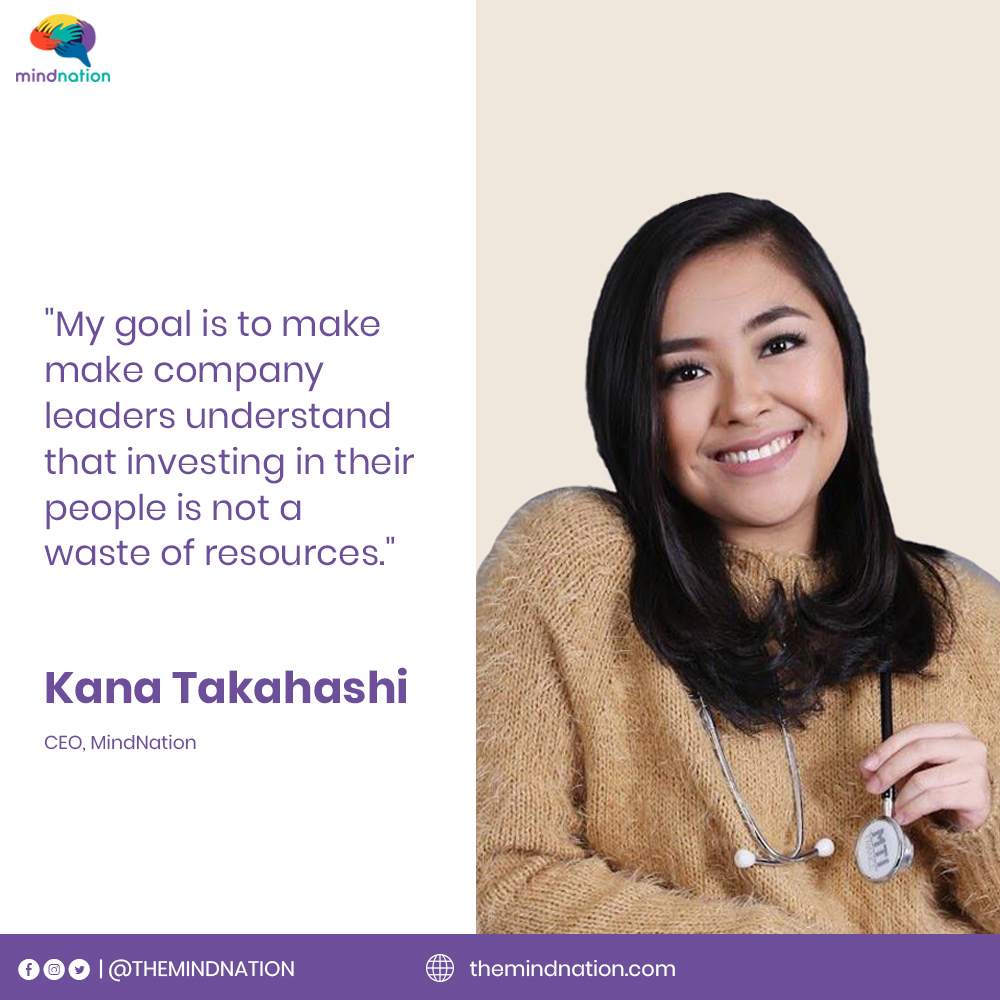
A CEO of any other start-up would have wrung their hands and panicked, but Kana was unfazed. “I didn’t get worried because I knew that what we were doing had value,” she says. “It was just a matter of making companies understand that — especially with the pandemic — investing in people is not a waste of resources.  Before the pandemic, all that companies wanted to see were numbers — ‘How can the mental health program that you are offering me boost my revenue?’ ‘What’s the ROI?’  But because of the pandemic, we were able to shift their mindset from ‘How can this benefit my business?’ to ‘How are my employees doing?’

Going above and beyond

And while other companies looked for ways to tighten their belts during the pandemic, MindNation did the opposite — they started offering their teletherapy services for FREE to the sectors most affected by COVID-19, from Philippine-based employees and students, to retrenched employees, medical frontliners, and even to members of lesbian, gay, bisexual, transgender, and queer (LGBTQ+ community). 

“We partnered with amazing mental health advocates like Senator Risa Hontiveros, as well as LGBTQ+ organizations, and women’s organizations to offer these pro bono services,” Kana points out.  “The fact that many non-government organizations were willing to work with a business like us — which is very rare — is proof that they saw the value in what we were doing,” Kana says.
Growing strong

Today, MindNation has a team of 50 employees and 20 psychologists, some of whom are located in other parts of the world. The company is now partners with over 40 organizations across industries, has expanded into Middle East North Africa (MENA), and is currently looking to grow more in other parts of the world.  In addition, they have gone beyond offering their services solely to organizations; individuals with mental health and well-being struggles can now also avail of the company’s 24/7 teletherapy sessions.

“MindNation’s vision is to build a world where mental health is valued, accepted, and supported,” Kana explains. “And we can only do that by making mental health care accessible to all.”

Best assets

Kana attributes the company’s growth and success to its team. “Every successful company has great people, people who go to work not just to work but to actually make a positive impact,” she says. “That’s what I‘m really proud of. In MindNation, we don’t work to feed the pockets of certain people, we do it because we’re working on life changing things.”

When it comes to supporting mental health in the workplace, the company walks the talk and has made the mental health programs that it offers to its client-partners available to employees as well. MindNation team members have access to 24/7 teletherapy sessions with psychologists and WellBeing Coaches and mental health leaves with pay. “The culture inside is also great, we can talk to each other about work and personal matters while maintaining a good working dynamic,” Kana shares. 

Looking ahead

Kana is looking forward to taking up post-graduate studies related to mental health so that she can grow the company more and support more employees. “Personally, I want to be able to help as many people as possible, even in little ways, whatever help looks like for them,” she affirms. 

Partner with MindNation to build happier, healthier, and more productive employees. Message us on https://bit.ly/mn-chat or email [email protected].

Categories
How To

5 Ways To Step Out Of Your Comfort Zone And Achieve Real Growth

Harrison Ford was a carpenter before being casted as Han Solo in the “Star Wars” movies. Today, he is one of the world’s best-known actors and an enduring pop culture icon. 

When Michael Jordan retired from basketball in 2003, he shifted to professional baseball and then to running his own business.  In 2014, he became the first billionaire player in NBA history; he is also currently the 5th-richest African-American. 

Finally, Sara Blakely was selling office supplies door-to-door when she got the idea for making shapewear; the company that she founded is now a household name — Spanx. 

What do these people have in common? They all got to where they are now by stepping out of their comfort zones.

What’s your comfort zone?

A comfort zone is not a physical place. It is a frame of mind, a place where you feel comfortable and your abilities are not being tested. In other words, comfort zones are comfortable, safe ways of living and working, usually in a set routine. 

Staying in one’s comfort zone has its advantages — you have zero stress, you complete tasks faster, and you don’t expend as much mental energy.

However, it also has its drawbacks — you don’t learn new skills, become complacent, and even miss out on opportunities for growth. 

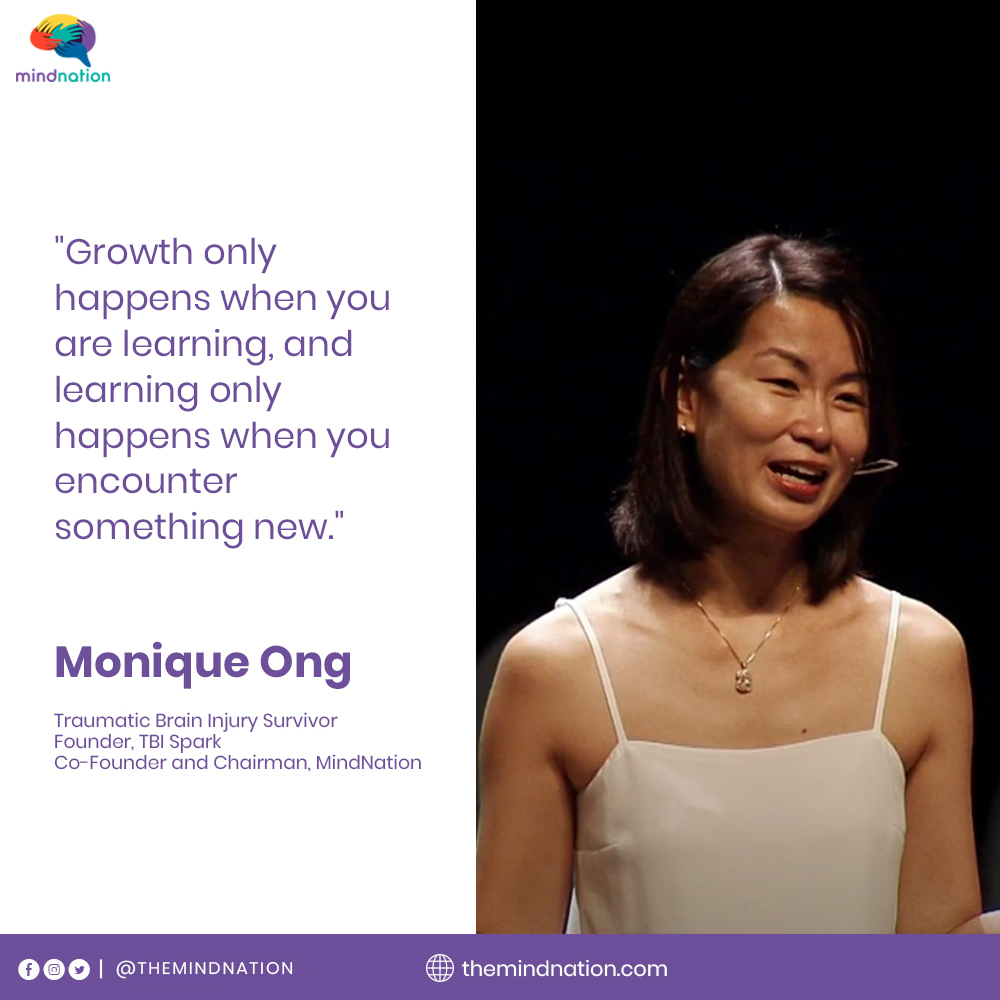
Remember that growth only happens when you are learning, and learning only happens when you encounter something new. When you make changes and take risks, you transition and even evolve into someone better, and sometimes in the process you even transform those around you.

The story of my life

My life has been all about expanding my comfort zones. After graduating top of my class from one of the most prestigious universities in the Philippines in 2000, I embarked on a storied career in Marketing for three Fortune 500 companies for over two decades, lived in seven different countries in the process, and even started my own business. But in June 2017, while on a business trip in Singapore, I sustained a severe traumatic brain injury (TBI). I spent 21 days in a coma and had to undergo three brain surgeries. When I woke up, I did not know how to eat, sit, or walk. Doctors told me that because of my injury, my brain was now only operating at 40% capacity. I was also diagnosed with aphasia, a disorder arising from a severe TBI that causes the patient to have trouble speaking, reading, writing, and understanding language. And finally, because of the swelling in my brain, I became blind in one eye. 

“Changes don’t have to be big, and they do not have to happen overnight. By simply being creative, you can make small tweaks to your routine while you are on lockdown and already challenge yourself.”

Digging deep

I was told that with therapy, my brain capacity could improve up to 80% — at the most. But I refused to let doctors determine my fate; in my quest to return to my normal life, I challenged myself and those tasked to treat me. I demanded daily speech therapy, even if my therapists only suggested that I see them thrice a week. I also asked for homework, and spent every day answering grammar worksheets, writing in a journal, and practicing giving presentations. I even started a light boxing exercise regimen with my physical therapist. On top of all these, I resumed planning for my wedding, which would be held 11,000 kilometers away in southern France.

 When she I tested by my neurologist six months after my accident, my brain was operating at 95%. 

In 2019, I co-founded MindNation, an innovative mental health and well-being company that has grown globally as a trusted partner for organizations and communities alike. I am proof that if we step out of your comfort zone, take risks, and face challenges head-on, we can evolve our lives, relationships, and even careers into something better. Maybe not right away, and definitely not guaranteed; but at least there is that possibility.

From the comfort zone to the growth zone

This is not to say that you do need to experience a life-altering accident to challenge yourself, or move to another country to experience taking risks. In addition, the COVID-19 pandemic has made it virtually impossible for us to have adventures. But all these do not mean we have to resign ourselves to a life of idleness and inactivity. Changes don’t have to be big, and they do not have to happen overnight. By simply being creative, you can make small tweaks to your routine while you are on lockdown and already challenge yourself.

Here are some of the things I do to continuously challenge my comfort zone even when I am homezoned: 

  1. Exercise.  

    Working out is synonymous with challenging yourself. I am currently working with a personal trainer online, even though exercising is one of the things that I don’t like to do. Because of our one-on-one set-up, my coach is constantly focused on me, always telling me to squat lower or bend deeper. I hate it, but I end up learning that I can do things I never thought possible.


For those who love exercising, one way to stay challenged is to change up your workout program from time to time. Don’t just brush off yoga because you think you’ll never be able to touch your toes or disregard strength training because it seems intimidating. Stepping outside your fitness comfort zone can help you spice up your routine, help break a fitness plateau, and even increase your motivation. 

  1. Veer away from comfort foods.

    Trying new dishes is one of the easiest ways you step out of your comfort zone. If you’ve been having your meals constantly delivered like me, order a dish that you’ve never ordered before or that you think you’ll never like, or buy from a different restaurant entirely. Even if you end up not liking the food, you are slowly training your brain to adapt to risk-taking. Next time, when you take on bigger challenges, they won’t seem so scary anymore.
  2. Make lockdown date nights as close to real date nights as possible.

    Before lockdowns happened, date nights meant dressing up, candlelit dinners at romantic restaurants, and evenings filled with meaningful conversations. But if you and your partner have been isolating at home 24/7 for more than two years now, there are ways to break this routine and rekindle the spark.

    When my husband and I order food on date nights, we make sure to remove them from the takeout containers and place them on real plates. We also use real utensils and bring out the formal glassware — even if we’re just drinking water. Finally, we make sure to dress up, sit facing each other at the dining table — not in front of the tv — and put our phones away for 2 hours so that we can have an honest-to-goodness conversation. These take a lot of effort, but in doing so we make the experience more meaningful.
  1. Dare to have uncomfortable conversations. 

The pandemic has made talking to friends boring because there is no longer anything new to share. “‘What’s new with you?’ ‘Nothing, I’m still stuck at home like you.’ So instead of asking people about their day during virtual catch-ups, I suggest introducing topics you never used to talk about, like world affairs or philosophical questions. These may be boring topics, but talking about them can help everyone learn something new and even take your relationship to a whole new level.

  1. Expand your professional skill set.

    I may be the chairman of a company, but I still block time in my calendar every day for strategic thinking and planning. This includes updating myself on what competitors are doing, reading up on industry trends, and holding discussions with the team to stay on top of issues and concerns. By doing these, I grow not only myself but also the business.

Not a C-suite executive? You can still challenge your professional comfort zone even if you are a junior team member. Take on an extra project on top of what you are already doing — being mindful of your own capacities and limitations, of course. Another way is to enroll in that digital marketing course, for example, even if you don’t know the difference between ‘reach’ and ‘engagement.’ Or reach out to your manager and ask if you can schedule a short meeting, to get feedback and advice on your current path.

Investing in skills like these not only represent a new challenge, they can build resilience, foster creativity, refresh your confidence, and open up more opportunities than ever.

To do or not to do, that is the question

At first glance, there is nothing wrong with choosing to stay in your comfort zone. Here, you stay safe, predictable, and it’s not as if you will kill anyone for doing so. But what it will kill is any purpose, meaning, or surprise in your life. When you don’t try new things, you won’t have any excitement, originality, or new motivation about anything.

The COVID-19 pandemic is causing us to change our perspectives on how to live, act, and interact with others. Use the time spent in lockdown to look for opportunities that will challenge your comfort zone; the result is either you say ‘This really isn’t for me,’ or you become so comfortable with the experience that you grow from it and it becomes your new comfort zone.

MindNation’s WellBeing Coaches are available 24/7 for teletherapy sessions if you are feeling stuck or unmotivated. Book a slot now through https://bit.ly/mindnation-book or email [email protected]

Categories
Employee Wellness

Stop Idolizing Overwork: 7 Things You Can Do To Overcome Hustle Culture

Are you constantly on the go? Do you devote 110% of yourself towards your work or other responsibilities? Do you feel guilty for putting your feet up, taking a day off, or even taking a nap? Is your mantra “I’ll rest when I’m dead?”

If you answered “Yes” (or even a firm “Maybe”), you are part of the hustle culture, also known as “Burnout Culture,” “Toxic Productivity,” or “Workaholism.” “Hustle culture is this mindset that we have to work hard to be considered productive and exemplary, and that if we don’t, we are useless and worthless,” explains yoga and mindfulness facilitator, educator, and licensed psychologist Ria Tirazona

While working hard is important, the hustle culture practice takes it to another level. “Working hard means you devote your time and energy to something that’s important to you, but you’re still able to take care of yourself,” Ria points out. “On the other hand, hustle culture is telling yourself ‘I’ll rest when I’m dead.’”

“Rest is not the enemy, and slowing down is not wrong. You need to change the attitude that not producing any output means we are not worthy. Hustle culture can be changed, and the change has to start with you.” 

Ria Tirazona, Psychologist and Mindfulness Facilitator


Who is impacted 


Hustle culture is not just practiced by executives and employees; students are branded “mediocre” or “lazy” when they do not pull all-nighters, while stay-at-home parents are shamed for everything from not preparing Instagram-worthy food to raising paragons. 

Even worse, we are oftentimes our own worst judges. “As a teacher, I constantly feel the need to study more, to take another course, to get another certificate,” Risa shares. “Before, I did it as part of continuing my education to improve my skills; but now it’s like I need to collect more proof that I am competent.”

“We have become consumed by this need to have more, to produce more, to be more. And if we choose to do the opposite, which is taking it slow or easy, we are negatively judged,” she adds.

How it came about

The rise of hustle culture can be attributed to advances in technology — everything is so accessible now that the line between yourself and your job has blurred. “Before the advent of email and instant messaging, we had to wait until the next day to get the memo for the tasks that needed to be done. Now, we get emails at two o’ clock in the morning,” Ria points out.

Ironically, while the COVID-19 pandemic has amplified hustle culture, it has also shed light on its negative effects.

“On one hand, because the lines between work and home are blurred, companies expect that employees can produce more output because they’re ‘just at home,’” Ria explains. “And if you’re an employee in a company that’s struggling to make it, of course you’re going to hustle to keep your job.”

But to some degree, the lockdowns have also caused people to start becoming more aware of the negative effects of hustle culture — burnout, stress, anxiety, and poor physical health. “Because life is harder now, there is a growing number of people who are starting to say ‘No, I can’t do this,’” Ria shares. “More and more groups now are also highlighting the importance of mental health and well-being, which was not really talked about pre-pandemic.”

How to cancel hustle culture

If you want to stop toxic productivity and take care of yourself better, here are some things you can do:

  1. Ask yourself — “What is my ‘rest narrative?’” “If your mindset towards rest is that it’s bad and it’s laziness, then you will continue to overwork because you don’t want to be called ‘bad’ or ‘lazy,’” Ria says. “But if you believe that rest is a healthy way for you to care for your well-being and a space to connect with what is important, then your attitude will change.”
  2. The second question to ask yourself — “Is hustling really worth it?” Refusing to hustle when everyone else in your organization is doing it can be scary — it can cost you goodwill with team members, a promotion, or even your job. “But as much as we want to go with the flow, there’s also a lot of value in going against the flow,” Ria advises. “You cannot keep going with a system that will cost you your physical and mental health, your relationships with loved ones, or even your life. So maybe it’s time you stand up for what’s important to you — money, prestige, or your health?”
  3. Set and enforce boundaries. France recently passed a law making it illegal to send work messages after office hours. If you live in a country that does not have this law, take it upon yourself to decide when to stop working, and don’t be afraid to communicate this to others. “We also have to give people the benefit of the doubt — sometimes they’re not even aware that they are causing you to overwork,” Ria explains. “So we need to take it upon ourselves to advocate for change.”

A tactful way would be to reply to an after-work email with “Thank you for this email, I’ll respond to it in the morning/on Monday.” After a few times, your colleagues will know not to do it again. 

However, do know that not everything you ask for will be granted. There will be times when you will need to work longer or harder — to meet a deadline or take care of a work emergency, for example — so you should also be flexible when needed. Just be sure these are exceptions, and not the norm. 

  1. Make rest and self-care a lifestyle. “Rest should be a part of your everyday experience, not a special occasion,” Ria says. “So don’t wait until you’re sick or burned out to rest, which is what the hustle culture emphasizes. Slowing down is good because in that little place of pause, you actually become more productive because you’ve cleared the clutter from your mind.”
  2. Specifically, take a nap. If there is one thing that Ria advises people who want to stop overworking, it’s to take an afternoon snooze. “Naps have been proven to boost brain health, reduce fatigue, and improve our well-being,” she says.
  1. Know your “flow.” Note that resting is not the same as being unwilling to push yourself further. “We all want to be the best versions of ourselves; but part of that is knowing our capacities and when we’re starting to lose that capacity,” Ria explains. 

Psychologists call this the “flow,” a state of mind in which you become fully immersed in an activity, your whole being is involved, and you’re using your skills to the utmost. It is also a dynamic and ever-changing state. “Sometimes you’re at your peak and you’re challenged, other times you need to recover,” she says.  “So go ahead and challenge yourself, but be aware of signs when you need to take a break.”

  1. Follow the rhythms of nature. “Two forces exist in the universe. Yin is a passive, negative force, while yang is an active, positive force,” Ria teaches. “And these forces exist everywhere in the world, even inside us. So there will be times when we are more active, which is yang; and there will also be times when we need to slow down, which is yin.” Both need to be balanced so we achieve better well-being. 

Another way to look at our energy is to compare it to the cycles of the moon. “You can be at a phase when you’re creating something new, when you’re working hard, and you’re producing a lot,” she says. “But there’s also that phase of emptying out and recovering, so that you have something to draw from again.”

“Rest is not the enemy, and slowing down is not wrong,” Ria concludes. “You need to change the attitude that not producing any output means we are not worthy. Hustle culture can be changed, and the change has to start with you.” 

If you are experiencing burnout, stress, or anxiety as a result of hustle culture, MindNation’s psychologists and WellBeing Coaches are available 24/7 for teletherapy sessions. Book a session now https://bit.ly/mn-chat

Do you feel that your organization exhibits toxic productivity? Partner with us to build happier, healthier, and more productive teams. Message us at [email protected] to know more about our services. 

Categories
Employee Wellness

4 Steps To Beating Burnout

Think back to the day you reported to work for your very first job. Whether that job was your dream role or a stepping stone towards a greater path, I’m sure you approached it with vigor and excitement, savoring the rush of getting things done, putting new ideas to the table, and proving yourself to your peers and bosses.

Unfortunately, this rush does not last. As time passes and more work and responsibilities come in, we start to feel stress. And it’s not just with work — anything that we used to invigorate us that we have to do on a repetitive basis such as relationships, house chores, or taking care of a pet can suddenly feel like another box we have to tick. It can even get to the point where we can’t seem to drag ourselves off bed simply because we’re spent. We don’t feel plugged into the role or the things we need to do anymore. 

Is this burnout? Or are we just tired? 

“Burnout is not considered a mental illness. It is, however, still a mental health issue because if left unresolved, it can lead to reduced productivity and sap our energy, leaving us feeling depressed, cynical, and resentful.”

World Health Organization

Burnt out or tired?

Tiredness is defined as the state in which one desires to sleep or rest. Once we have done either of the two, the tired feeling goes away and we can carry on with our other activities normally. It’s normal for everyone to feel tired.

Burnout, however, is being over-tired – it is a state of emotional, physical, and mental exhaustion caused by excessive and prolonged stress. The term was first coined by German-American psychologist Herbert Freudenberger in 1974 after observing the volunteers of a clinic for addicts and homeless people in New York City. The clinic’s volunteers were struggling with their intense work and according to Dr. Freudenberger, the stress of the job was causing them to feel demotivated and emotionally drained. Though they had once found their jobs rewarding, they had become cynical and depressed; they weren’t giving their patients the attention they deserved. 

According to the World Health Organization (WHO), burnout is not considered a mental illness. It is, however, still a mental health issue because if left unresolved, it can lead to reduced productivity and sap our energy, leaving us feeling depressed, cynical, and resentful. Burnout can also cause long-term changes to our body that makes us vulnerable to illnesses like colds and flu.

Symptoms of burnout

How can we tell if we are burnt out? According to the WHO, there are three symptoms to watch out for:

  1. Physical. Apart from feeling tired and drained most of the time, people who are burnt out also find it difficult to sleep. They also experience lowered immunity, frequent illnesses, frequent headaches, or muscle pain but laboratory tests reveal nothing is wrong.
  1. Emotional. These include feelings of doubt, helplessness, a sense of failure, of being trapped, loss of motivation, an increased negative outlook, and feeling detached or dissatisfied with no sense of accomplishments.
  2. Behavioral. Examples of this include lowered productivity, withdrawal from responsibilities, isolation, using food/drugs/alcohol to cope, procrastination, having a short fuse, skipping work or coming in late, and wanting to always leave early. 

If these apply to you or your team’s situation, it’s time to take action. Because of its many consequences, it’s important to deal with burnout right away.

What to do?

Here are some steps you can take when you spot the signs of burnout, as well as how to avoid it from happening:

Step 1: Recognize the state you are in

While many of us already have an inkling that we are in a state of burnout or approaching one, we tend to brush this feeling under the rug because we don’t want others (especially our bosses) to mistake our lowered productivity and detached feelings as laziness or an inability to cope with the demands of work. But we are not robots; It’s normal to experience burnout. This is why we need to conduct regular self check-ins to make sure we know what state we are in and take the appropriate countermeasures.

We can start by asking ourselves these questions: 

  1. Am I feeling cynical or negative about work, and are these feelings escalating?
  2. Is my motivation decreasing?
  3. Is it becoming difficult to perform work-related problem solving?
  4. Do I feel myself getting more agitated or angry at work?
  5. Are interpersonal difficulties at work spilling over into my home life?
  6. Do I feel depressed as a result of work-related stress?
  7. Is work-related stress causing my anxiety?

If you answered yes to all of these questions, you are either burnt out or close to being so.

If you are unsure, you can take MindNation’s WellBeing Quiz. This is a FREE, 2-minute TRUE or FALSE test to check if you are Thriving, Healthy, Decent, Fading, or Burnt Out. 

Step 2: Know your WHY

Once you have gotten the lay of the land and honored your state, dig deeper and ask yourself, WHY. Apart from income, why are you doing your job? This is because when we talked earlier about losing vigor to do the things that used to excite us, it can be largely driven by our loss of clarity or sight of our “why.” We simply don’t know why we do things anymore, and it can be easy to get lost in the many things happening around us today with the pandemic and personal stress. When we’re aligned with our why, it’s a different kind of fuel or charisma that makes things happen and gives us focus.

Step 3: Go back to the basics.
This means keeping hydrated, eating healthy, and recharging to the fullest.  Always remember that recovery from burnout is a slow journey and requires daily rest. It is not something that can be fixed in a day or even in just a week; research has shown that vacations don’t cure burnout. While burnout levels do decrease during vacation, they often return to pre-vacation levels within a week or two after returning to work. This is why the next step is important.

Step 4: Build habits that cultivate resilience

Taking care of our mental health is all about our mental strength. It involves developing daily habits that build mental muscle, which may also involve giving up bad habits or toxic stressors that do hold us back. When we hone our mental muscle, it’s like going to the gym consistently; we become stronger versions and it is something we have to discipline ourselves to do. 

Some ways to do this include:

  • Setting boundaries. This can avoid you from spreading yourself too thin, especially when you’re on the brink of burnout. So set limits on the time you give to others to help you manage stress while recovering from burnout. It doesn’t mean avoiding a person all together, but avoiding a specific habit, behavior, or ask that may be pushing you to your limit. Be firm about your needs. Talk to others involved and let them know what’s happening. Explain that you need some support in order to take care of your health and manage your workload productively.
  • Prioritizing work-life balance. Once you leave work, focus on relaxing and recharging for the next day.
  • Seeking professional help. Increasing your well-being is not always easy, especially when you’re at your lowest. So seek help from those around you, and from trusted professionals as soon as possible. MindNation’s licensed psychologists and WellBeing Coaches are available 24/7 for teletherapy sessions if you need help managing stress or building better habits. Book a session now through bit.ly/mn-chat or email [email protected]. Rest assured that all conversations will be kept secure and confidential.
Anxiety is caused by our fear for the future and things that may not have happened yet. Our awareness with what’s happening now and acceptance will help us create that leeway we need to plan for what’s to come.

MindNation partners with like-minded organizations to provide holistic well-being programs, psychologist consultations via teletherapy, and Company Culture Drive talks to build happier, healthier, and more productive teams. Visit us at www.mindnation.com or email [email protected] to know more. 

Categories
Children's Mental Health

8 Ways To Raise Kids To Be Allies

Being an ally of the lesbian, gay, bisexual, transgender, and queer (LGBTQ+) community is not just about knowing LGBTQ+-related vocabulary by heart or lobbying for trans-inclusive bathrooms. Even young children can be considered allies when they treat all people — regardless of their sexual orientation, gender identity, gender expression, or sex charactertistics (SOGIESC) —  with compassion, acceptance, and respect. 

“Raising kids to be kind and accepting benefits not just the recipients of those kind acts but also the children themselves,” says Dr. Kathryn Braganza, a neurodevelopmental pediatrician practicing in Manila and mother of two children aged 18 and 6. “Being kind will make them feel good about themselves, ease their anxieties, make them happier, and boost their self-esteem.” 

While it is easier to teach children to be allies when a relative is queer, even families without homosexual, bisexual, or transgender loved ones can raise children to be open and loving. Dr. Braganza, who also has a gay older brother living in the United States,  shares some tips from her personal experience on how parents can create a culture of kindness and inclusivity at home:

“When my husband makes inappropriate jokes, for example, I call him out in front of the kids in a nice way. In other instances when it’s okay to do so, I politely share science-backed data to counter other people’s stereotypes and misconceptions.”

Kathryn Braganza, Neurodevelopmental pediatrician
  1. Embrace diversity. From a young age, expose your children to people, shows, music, or literature that positively represent a variety of SOGIESC. “In the building where I live, we have a transgender neighbor who dotes on my six-year-old daughter, hugging and kissing her all the time,” relates Dr. Braganza. “And because my husband and I did not make an issue out of it, my daughter thinks of her as just a loving neighbor and not ‘that transgender neighbor.’” 

Many television shows now also have diverse casts and roles, so Dr. Braganza suggests that parents co-watch with children to better explain to them what they are watching. 

Finally, let your sons wear pink, your daughters wear blue, and let them play with whatever toys they want. “In developmental pediatrics, we encourage parents to let kids engage in pretend-play, such as playing with dolls, to boost socio-emotional skills,” Dr. Braganza says. “Some parents have told me they are hesitant to let their sons play with dolls because they worry it would make him more feminine, but I just explain to them that research has shown that toys do not determine or influence gender identity.”

  1. Emphasize WE, not ME. Encourage your child to look for what they have in common with others instead of how they are different. Any time your child points out how someone is unlike them, Dr. Braganza suggests that you say, “There are lots of ways people are different from each other. Now let’s try to think of ways you are the same.” 
  1. Encourage open and accepting minds. “You can model this in everything you do, even in situations that are not related to gender,” says Dr. Braganza. “When your kids see you treating everyone the same regardless of their social status or their appearance, they will also do it on their own.”
  2.  Openly speak with pride and love about family members, friends, and colleagues who are LGBTQ+ (as long as they are out and are comfortable with you discussing them with others).  “My brother came out to me and my parents just before I got married and we supported him whole-heartedly,” Dr. Braganza recounts. “So when my children were growing up, his sexual orientation was never an issue because they saw that their grandparents and I did not treat him any differently than other people. Before the pandemic, we would all even frequently visit him and his husband in the US and my children treated their relationship as something normal.” 
  1. Be mindful of hurtful or derogatory comments or behavior. Children are always watching, so they will notice kindness, respect, and when you speak up on behalf of someone receiving unfair treatment. “Of course, choose your battles,” Dr. Braganza clarifies. “When my husband makes inappropriate jokes, for example, I call him out in front of the kids in a nice way. In other instances when it’s okay to do so, I politely share science-backed data to counter other people’s stereotypes and misconceptions. But when the hurtful remarks come from an elederly relative, for example, I just say quiet to show respect, but once we are at home I explain to the kids that what they heard was not right.” 

“I also frequently tell my children that everyone is raised differently, so if other people give a different point of view, just be polite but at the same time they should be firm in their belief that they know what is right,” she adds. 

  1. Answer children’s questions simply and honestly. How you respond can either create stereotypes or prevent them from forming. For very young kids, usually a one- or two-sentence answer is enough. Dr. Braganza gives some examples:
  • “Mommy, he’s a man but why is he wearing makeup/dressing like a woman?” 

Answer: “That’s what he likes to do, it looks nice anyway, right?”

  • “Daddy, he is a boy, how can he be a girl?” (when referring to transgenders)

Answer: “He likes to be one, there’s nothing wrong with that.”

  • “Why does she look like that/talk that way?” (when referring to someone with a different gender expression)

Answer: “That’s how she likes to look or talk, there’s nothing wrong with that.”

In any situation, always tell your child that everyone has the right to choose how they want to express themselves,” she says. 

  1. Ask yourself one critical question every day: “If my child had only my behavior to copy, would they be witnessing an example of what I want them to emulate?” “So always model kindness and optimism,” explains Dr. Braganza. In doing so, your children will learn to be allies and treat everyone with compassion and kindness. 
  1. Update yourself on the latest facts about the LGBTQ+ community. There are many myths and misconceptions about sexual orientation and gender identity, so it is important that we educate ourselves to avoid inadvertently  projecting obsolete ideas onto our children and tainting their views. “Update yourself with what science tells us about SOGIESC,” she suggests. “The internet has a wide array of information to get you started.” 

MindNation also gives talks on SOGIESC in partnership with Balur Kanlungan, an online wellness community for LGBTQI youth in the Philippines; just email us at [email protected] to set a schedule. 

If you need help on improving your communication skills or forming a closer relationship with your child, our psychologists and WellBeing Coaches are available 24/7 for teletherapy sessions. Rest assured that all conversations will be kept secure and confidential. Book a slot now through FB Messenger http://mn-chat or email [email protected].

Categories
LGBT Mental Health

7 Ways To Support A Loved One Who Is Transitioning (From Male To Female Or Female To Male)

Gender transitioning is the process in which a person begins to live according to their gender identity instead of the gender they were assigned at birth. Possible steps in a gender transition may or may not include changing one’s clothing, appearance, name, or the pronoun used to refer to them (see below). In countries where it is legal to do so, some are able to change their identification documents, like their driver’s license or passport, to reflect their gender. Finally, some people undergo hormone replacement therapy or other medical procedures to change their physical characteristics and make their body better reflect the gender they know themselves to be.

Transitioning can take at least several months or even longer. “Transitioning is for life if you want to go all out — meaning you transition not just socially but also legally and medically,” says magazine editor Jebby Fronda. “Once you start taking hormone replacement therapy pills, for example, you can never stop doing so.”

There is no specific set of steps necessary to “complete” a transition—it’s a matter of what is right for each person. In Jebby’s case, her transition started back in in high school when she first came out to her parents as a homosexual boy. “Back then, I did not know yet that there was such a thing as transgenderism,” she explains. “I only knew that I was attracted to boys, so I told my family that I was gay.” 

But as time went by, she still felt there was something missing with her identity. “I realized I was not attracted to gay men; what I wanted was a relationship with a man who saw me as a woman,” she points out. 

Jebby’s epiphany came in 2014 when she watched the TED Talk entitled “Why I Must Come Out” by Geena Rocero, a Filipino-born American model and transgender advocate. “My mind was blown,” she relates. “I forgot the details of how I came out to my family the second time around, but I just knew that being a transwoman was what was right for me.”

“I respected their decision and told them we would discuss it again after a year, because one thing that I realized during my transition was that I have to give other people a chance to transition as well, that it’s also a process for them.”

Jebby Fronda, Magazine Editor

Today, Jebby is in her sixth year of transitioning but she describes her process as incremental. “Early on, I wanted to get top surgery so I could have breasts. But my parents told me they were not yet ready for me to do that because they felt the procedure was too invasive,” she explains. “I respected their decision and told them we would discuss it again after a year, because one thing that I realized during my transition was that I have to give other people a chance to transition as well, that it’s also a process for them.”

One of the milestones in her transition came in November 2020 when she was finally able to wear a swimsuit in front of her family. “Prior to that trip, my family always insisted that I wear shirts and trunks. Because I knew they were still adjusting to my gender identity, I didn’t press the issue, I just told them that I wouldn’t go swimming anymore.”

So it was a pleasant surprise when Jebby’s family finally allowed her to wear a swimsuit in November. “Of course I was happy, but at the same time, I also felt scared because I knew it was going to be awkward,” she confesses. “But when no one even batted an eye after that first day, I became more at ease and wore a swimsuit throughout the whole trip.” 

Another turning point also occurred last year when Jebby asked her father if he could buy her hormone replacement therapy pills during one of his trips to the drugstore. From then on, her father would constantly ask if he needed to replenish her supply. “It’s such a small gesture but it means the world to me because it shows progress in my family’s acceptance of me,” Jebby shares.  

Jebby’s story shows that regardless of what steps are involved or how long it takes, transitioning is a process that is filled with  a roller coaster of emotions, so the importance of a support system through this process cannot be overstated. “It is very important to support someone transitioning because it is a scary time for us,” she shares. “We feel very alone because at the end of the day, society does not accept us and when we first come out there is always the fear that we will not be accepted by our family or friends. This is why I am very thankful that my family transitioned with me.” 

Jebby shares some ways family members and friends can be a rock for a transitioning family member or friend’s life:

  1. When they first come out to you, congratulate them. “Transitioning is really a cause for celebration because it means the person has finally broken free from feeling trapped and confident enough to tell someone else who they really are,” Jebby explains.
  2. Ask what name or pronouns they would want to be called. Possible pronoun choices may include he/him, she/her, ze/hir, and they/them. Ze/hir and they/them (used to refer to an individual, not a group) are gender-neutral pronouns and are being used by more and more people who don’t feel like he/him or she/her adequately describe them. 
  1. Assure them that you will be there for them. “What we really need during this daunting time is a hand to hold and a listening ear,” Jebby says.
  1. Feel free to ask questions. Ask your loved one to explain to you how he/she/they found out they were transgender. “Let them tell you their story, so you can understand them better and it will not feel as if they are going through their journey alone,” Jebby says. “Also ask what else you can do for them to show your support.”
  2. Respect their privacy. Just because your transgender loved one has told you something about their experiences doesn’t mean they want everyone else to know. It is up to them to decide how much information is being shared, so ask permission first if you need to tell other people.
  3. Educate yourself. Show your loved one that you care by educating yourself on everything from the challenges the transgender community face, such as harassment, to the latest LGBTQ+ vocabulary. Jebby recommends that loved ones also watch Geena Rocero’s TED Talk (available on YouTube) and even read young adult books about being transgender (just search “Transgender” on Goodreads). 
  1. Advise them to see a doctor if they want to transition medically. “This is to make sure everything is done safely and flawlessly,” Jebby explains. 

“Being a good ally to someone transitioning is all about opening your communication lines,” Jebby summarizes. “Even if you read a lot about transitioning and transgenderism, the experience is different for each person so at some point you really have to ask your loved one what he, she, or they need. Be open to that conversation, even if it’s awkward or scary.” 

Transitioning is an emotional experience for all parties involved. If your loved one is transitioning and you find yourself struggling, MindNation’s psychologists are available for 24/7 teletherapy sessions to help you process what you’re feeling. Book a session now through FB Messenger http://mn-chat or email [email protected].

Categories
LGBT Mental Health

10 Ways To Support A Loved Who Is Questioning Their Sexual Orientation Or Gender Identity

Last time, we gave tips on what to do if a loved one explicitly comes out to you. But what should you do if your child, close friend, or sibling “sort of” comes out to you? By this, we mean they are not really sure if they are gay, straight, or something else entirely, and they don’t know what to do about it. Chances are they are feeling scared, confused, and afraid of losing your love or friendship, but at the same time are in need of a sounding board. 

“Being queer is a struggle,” says Venue Aves, Punong Babaylan (Head Shaman) of the U.P. Babaylan, the longest-existing LGBTQI student organization in the Philippines and in Asia. “This is why it’s important to be a safe space for queer people, especially if they are questioning, because research shows that members of the lesbian, gay, bisexual, transgender, and queer (LGBTQ+) community are more vulnerable to developing mental health problems — including suicidal ideation — because of the problems that arise from society’s prejudice and non-acceptance of them.”

Here are some ways you can support a loved one who is questioning their sexuality or identity: 

“How they arrive at or express their sexuality is a journey; their identity does not have to be pinned down or labelled right away.”

Venue Aves, Punong Babaylan (Head Shaman) of the U.P. Babaylan
  1. Explicitly assure them that your relationship will not change. This is the most basic way that you can support your loved one. Say you love them, that they’re still your BFF, that you think nothing less of them. “The support and reassurance has to be explicit because more often than not, the one who is questioning will be afraid that your relationship will change or become complicated by their confession,” Venus says. “By being clear and affirming with support and encouragement that is unconditional, you allow your questioning loved one to express what they really feel.”
  2. Thank them for their trust. Even if your loved one knows that you’re an ally, verbalizing their fears can still be a really intense experience that takes strength and courage. Thanking your sibling, friend, or child shows that you honor this courage as well as the trust that they have for you.
  3. Don’t force them to come to a decision. Pushing them into a “gayer” or “straighter” direction — even if your advice is well-intended — puts undue pressure on the one who is questioning. Instead give them room to figure things out on their own. “How they arrive at or express their sexuality is a journey; their identity does not have to be pinned down or labelled right away,” they point out. 
  1. Listen more than you talk. Even if you are curious, questions like “Are you sure?” or “What if you’re just confused?” only adds to the pressure and complicates an already sensitive issue. If you must ask, ask what help or support your loved one needs from you. Otherwise, just listen, nod along, or be a shoulder to lean on. 
  1. Accept the fact that you cannot do everything. “Even if you are a safe space, the rest of society may not be,” they explain. “So if you can, ensure that your questioning loved one has access to support groups outside of your trusted circle.”
  2. Educate yourself. Do your best to understand the reality of being a member of the LGBTQ+ community. “Learn about Sexual Orientation, Gender Equality, Expression, and Sex Characteristics (SOGIESC),” they say. “Read books, listen to podcasts, or watch shows that show the experiences of LGBTQ+ people. These are all readily available online.”
  3. Educate others. If you follow social media accounts that promote LGBTQ+ equality, repost their content. “If your partner or parents are struggling with your child or sibling coming out or questioning, make the effort to talk to them and remind them that their loved one is still the same person and your love should not change,” they advise.
  4. If a close co-worker is the one who is questioning, strive to make the company more inclusive and accepting of diversity. “Petition your manager or HR department to invite organizations like U.P. Babaylan to give talks on SOGIESC, which can lead to the formulation of diverse and inclusive policies and make your workplace a safe space for queers and questioning individuals,” they suggest.
  5. Check-in on them regularly. “It’s really scary not to be straight, so communicate with your loved one often to make sure they are okay and to assure them that you are there if they need anything,” they explain. 

Refer them to a mental health professional if — and only if — your loved one has a history of mental health concerns or is displaying signs of depression, anxiety, or suicidal ideation. “But do not tell them to talk to a psychologist solely because they are questioning their sexual orientation or gender identity because homosexuality and transgenderism are not medical illnesses that need to be treated,” they add.  

  1.  Respect their privacy. Just because your loved one is processing their sexuality with you does not mean they want to be out to the rest of your family or friends, or even plan to be. Even though your intentions may be good (i.e. you want to be the one to tell your parents to spare your sibling the fear and anxiety), always ask your loved one first if that is what they want you to do. Outing someone who is LGBTQ+ without their permission can damage relationships or put them in awkward situations that they are not prepared for. 

It is important to create an inclusive environment for everyone. By simply affirming, supporting, and respecting your loved one’s questioning thoughts and feelings, you can already make a difference in their lives. 

If you are a queer person or know someone who is questioning, Balur Kanlungan (https://www.facebook.com/balur.kanlungan) is an online wellness community for LGBTQI+ youth in the Philippines and provide avenues for members of the community to be exposed to the LGBTQI rights movement.


For those who want to talk to mental health professionals, MindNation offers 24/7 teletherapy sessions with licensed psychologists and WellBeing Coaches. Rest assured that all conversations will be kept secure and confidential. Book a session now through FB Messenger http://bit.ly/mn-chat or email [email protected].

Categories
Featured

10 Takeaways From #LeadershipDuringCrisis: Tackling Mental Health During COVID-19 Virtual Roundtable

During Mental Health Awareness Month 2021, MindNation held its first ever virtual roundtable for business leaders to learn and discuss how the COVID-19 pandemic has affected mental health and well-being in the workplace. 

“Traditionally, topics like substance abuse, anxiety, and depression used to be considered personal matters and not addressed in the workplace,” explains MindNation Chief Marketing Officer Cat Triviño. “But the lines are now blurred and we can longer deny the effects of mental health concerns on an organization’s bottomline and overall success.

Philippine Vice President Leni Robredo kicked off the event by delivering the Welcoming Remarks, sharing that “Building a better normal means constantly recognizing that no single area of human health is more important than another.”

In addition, data experts and mental health advocates Ajay Bangia of global market research firm Ipsos and MindNation Chief Insights Officer Piril Yagli discussed how creating a culture that values psychological safety affects a company’s growth and success during these trying times. 

Finally, top industry leaders Merlee Jayme, Global President of advertising agency Dentsu Mcgarrybowen, Mark Lyndsell, CEO for the Global English Region of business process outsourcing company Transcom Worldwide, and Kevin Williams, Country General Head of cloud solutions provider RingCentral, offered insights and new ideas on the implementation of mental health programs. 

Here are some of the key points shared by the speakers:

“We must open more spaces to talk about mental health, create avenues where people can share their struggles comfortably without feeling ashamed, and foster an environment of love, care, and support.”

Vice President Leni Robredo
  1. Mental health and well-being issues are a growing problem in the workplace.

When Filipino employees were asked to rate their mental wellness pre- and post-pandemic on a scale of 0 to 10 (where 0 is “depressed” and 10 is “feeling my best self”), they felt an 8 before the pandemic versus a declining 6.5 after the pandemic.
 

According to Ajay Bangia, the depression, stress, and anxiety felt by people are due to job insecurity, work pressure, and difficulty handling work-life balance. 

Additionally, people are feeling a high degree of isolation. “Loneliness is one of the key sources of mental health and well-being challenges during this pandemic,” Piril Yagli of MindNation says. 

  1. No one is exempt from mental health challenges, but some are more affected than others.

In the Philippines, employees who are 18-30 years old, working the night shift, and who indicated their gender as LGBTQ (or would prefer not to say) are the ones most likely to be struggling with COVID-related fears, financial pressures, personal matters, work performance pressures, and juggling work and family life. 

  1. Women with children are also facing greater amounts of stress levels.

Because of the pandemic, working mothers have to juggle being full-time mothers as well as breadwinners. “Their whole day turns into a roller coaster of work, then kids, then house chores, then preparing meals,” Piril shares. 

“Home used to be a place for rest, now it has merged into our work life,” Merlee Jayme of Dentsu Mcgarrybowen adds. “Work has eaten into all of our personal space.”

  1. All these mental health and well-being challenges significantly impact the company– to the tune of PHP7 million per year (for every 1,000 employees). 

This amount is lost due to:

  • Absenteeism. 13% of employees said they would take a sick leave due to mental health and well-being challenges
  • Presenteeism. 35% of employees revealed they are unproductive at work for up to two hours a day — equivalent to losing one day in a week or up to two months in a year. 
  • Talent loss. 5% of employees in a company stated that they would quit their jobs due to mental health and well-being challenges. 
  1. Unfortunately, not everyone is open about their struggles.

Only 10% of employees would tell their superiors that they are taking a sick leave due to mental health challenges. This is because there is still a stigma surrounding mental health especially in the workplace. Employees fear that talking about depression, anxiety, or other mental health concerns will negatively affect how managers view them and their job performance.

  1. Three things that companies can do to address the mental health crisis in the workplace:
  • Create a Mental Health company policy. While the Philippines’ Department of Labor and Employment requires workplaces in the formal sector to implement Mental Health Workplace Policies and Programs, many companies still have not created such.
  • Stop the stigma by talking about mental health openly. “Leverage mid-level managers to talk with their teams, understand their challenges, and make them aware what help is available,” Piril suggests.
  • Lastly, partner with a mental health and well-being provider who cares. While many corporations do have Employee Assistance Programs, research has shown that the usage rate of these support systems are lower than 10% because most of them are not accessible 24/7 all year round. “It is important to partner with a mental healthcare provider that has psychologists and WellBeing Coaches who are available all day, everyday, so that employees can get help the moment they need it, rather than waiting until it is too late,” she adds.
  1. To create a workplace culture that values and supports mental health and well-being, managers need to be more empathetic and employee-centric. 
  • “Show empathy. Let your colleagues know you feel the same way they do, that you can talk about real things, not just revenues and client budgets,” Merlee suggests. 
  • “Mental health needs to be overcommunicated,” Kevin Williams of RingCentral shares. “When people come to you, ask the easy yet hard question, ‘How are you doing?’ ‘Are you happy?’”
  • “What we need today are leaders and organizations with a high degree of Emotional Intelligence,” Mark Lyndsell of Transcom Worldwide adds. “As a leader I’m willing to sacrifice IQ provided I have leaders who are grounded, transparent, authentic, and flexible.”
  1. Listen and understand the needs of the organization. 

47% of employees think they have too much work,” Piril shares. “So please make it a priority to talk to your teams, try to understand what they’re working on, is there anything that can be simplified, automated, or outsourced?”

  • “In our office, we have Wellness Wednesdays,” Merlee says. “These are no-meeting days that employees can use to catch up on work or just zone out.”
  • “At RingCentral, we have a quarterly company CaRING Day — adding a paid holiday and an extended weekend to every quarter to encourage our teams to disconnect from work and recharge,” Kevin adds
  • Employees of Transcom are encouraged to communicate openly with their leaders. “Every single day we poll our employees on how they are feeling; and if they are feeling down, to tell us why,” says Mark.
  1. It takes action and collaboration from all sectors to create happier and healthier spaces for all. 

“We must treat mental health as an important aspect of our healthcare agenda,” says Vice President Leni Robredo. “We must open more spaces to talk about mental health, create avenues where people can share their struggles comfortably without feeling ashamed, and foster an environment of love, care, and support.”

  1. There is no health without mental health. 

“The last 15 months of the pandemic has shone a spotlight on the mental health of organizations and many have been found wanting,” Mark adds. “I believe that there is so much more we can and should be doing, and as a leader it starts with me.”

According to Piril, the top 5 things that employees want to overcome their mental health and well-being challenges are psychologist services, WellBeing Coach consultations, training on mental health and well-being, fitness coaches, and sick leaves for mental health concerns. “For a mental health and well-being program in the workplace to be effective, the provider needs to listen to the voices of the employees, understand their challenges, and provide solutions specific to their needs,” she says. 

MindNation uses a data-based approach to create proactive, customized, holistic health programs for your employees. Partner with us to build happier, healthier, and more productive teams. Email [email protected] now!

Categories
Featured

7 Important Things Every Dad Should Teach His Kids

Fathers, like mothers, are pillars in the development of a child’s emotional well-being. Studies have shown that when fathers are involved, affectionate, and supportive, it positively impacts a child’s overall sense of well-being and self confidence. 

We asked Filipino journalist and father-of-three TJ Manotoc to share some things that  he wants his children — and every child — to grow up knowing so that they become healthy and happy individuals:

“My kids always ask me what my definition of success is, and I tell them it’s not how much money I earn or what kind of car I’m able to buy — it’s to raise them to become happy and healthy human beings.”

TJ Manotoc, Journalist and father of three
  1. For his sons, to always respect women. “There’s so much misogyny and disrespect for women nowadays that I want my sons to know that such behavior is not cool or funny and can really be hurtful,” he shares. “I always tell them that before they say or do anything to another girl or woman, they should first think about their own sister and mother, and how they would feel if they were the recipient of such disrespectful words or actions.”
  2. To know how to cook, clean, and do the laundry. “If you enter the adult world knowing how to do household chores, you will have a much easier time being loved,” TJ laughs. “And if you really can’t do chores or have the time — at least be neat and clean when you are living with someone else!”
  3. For his daughter, to be brave. “I believe it’s especially important to encourage girls to speak up for what they believe in, to use their platform for good and not just for aesthetics,” he says.
  4. And to learn self-defense! “The world is a scary place, and she should be able to protect herself and not wait for a man to come to her rescue,” he points out.
  5. For all his children, regardless of gender — that it’s okay to feel your emotions. “This is a bigger issue for sons because their feelings are stifled a lot. We should do away with toxic statements like ‘Be a big boy’ or ‘Be a man’ and allow our little boys to be human beings,” he opines. “If something bothers them, hurts them, or physically pains them, they should know that it’s okay to cry.
  6. Financial literacy. This includes how to take care of money, how to budget, what to buy and when to buy them, or how to invest. “I wish these were things my parents taught me back then and I hope that more parents teach it now, because finances are really something that a lot of people struggle with when they get into adulthood,” he says.
  7. To go ahead and dream. “Don’t stifle your child’s dreams by saying ‘No, you have to be a doctor,’ or ‘No, you have to do this, not that,’”
    TJ expresses. “Doing this puts a boundary on their dreams and tells them that they cannot be who they were destined to be. So allow them to spread their wings and expose them to as many things as possible so that they can discover their meaning in the universe.”

He adds: “My kids always ask me what my definition of success is, and I tell them it’s not how much money I earn or what kind of car I’m able to buy — it’s to raise them to become happy and healthy human beings.”

For TJ, the best way fathers can cultivate healthy and loving relationships with their children is to create opportunities where they can bond and spend time together in a very natural and relaxed manner. “One thing I struggle with is when I see families sitting down at the dinner table and the kids are “supposed” to bond with the parents, they are “expected” to share what went on during their way even if they are tired or in a bad mood. Instead of forcing the kids, parents need to find ways to pique their child’s interest and open them up to conversation,” he suggests. “Everyone has different moods — when they feel chatty or when they just want to be alone — so my advice to parents is to give their kids the space and time they need to be themselves. Trust and respect are essential to a positive parent-child relationship.”

Want to build a healthier relationship with your child? Our WellBeing Coaches are available 24/7 for teletherapy sessions to help you improve your communications skills and become a more empathetic parent. Book a session now through FB Messenger http://mn-chat or email [email protected]

Categories
Featured Men's Mental Health

6 Strategies To Get Men To See A Doctor

A 2019 study from leading medical and research center Cleveland Clinic found that 72% of men would rather do housework (such as cleaning the bathroom) than go to the doctor. 

Additionally, only half (50%) of men surveyed said that they consider getting their annual check-up a regular part of taking care of themselves.

So what makes men so hesitant to walk into a doctor’s office? According to the same Cleveland Clinic survey, the top reasons include:

  • They were embarrassed (46%).
  • They didn’t want to hear that they needed to change their diet/lifestyle (36%).
  • They knew something was wrong but weren’t ready to face the diagnosis and/or would rather not know if they have any health issues (37%).
  • They were told as children that men don’t complain about health issues (41%).

“More often than not, men don’t like seeing a doctor because they have a ‘macho ego complex’ and do not want to be perceived as sick or weak.”

Dr. Rainier Lutanco, a general, head and neck, cancer, and minimally invasive surgeon

“More often than not, men don’t like seeing a doctor because they have a ‘macho ego complex’ and do not want to be perceived as sick or weak,” says Dr. Rainier Lutanco, a general, head and neck, cancer, and minimally invasive surgeon based in Manila. “On the other hand, others view health care as a waste of time and money.”

If a man is unwilling to go to the doctor, it puts him at risk for missing preventive screenings — check-ups, immunizations, teletherapy, and other tests — which can help prevent physical or mental problems or detect them before they become major. This is especially important now as the Cleveland Clinic survey also showed that 77% percent of men reported an increase in stress levels as a result of COVID-19, 59% have felt isolated during the pandemic, and nearly half (45%) say their emotional/mental health has worsened during the pandemic.


How to motivate men to get medical attention

If you know someone that needs some convincing to put his health first, here are six approaches you can try:

  1. Don’t nag. Nagging is defined as the interaction in which one person repeatedly makes a request, and the other person repeatedly ignores it, and both become increasingly annoyed. Constant nagging can make the other party feel resentful, personally attacked, and inadequate.
  2. Don’t guilt-trip. Guilt-tripping is making someone feel guilty in order to induce them to do something. An example would be telling your husband or father “Who will take care of us if you get sick?” But this statement will only further shame the man and perpetuate the culture of toxic masculinity that says men should be the ones taking care of the family.
  3. Instead, come from a place of caring. Instead of positioning the doctor’s visit as another thing that he is expected to do, tell him that you want him to get checked because you truly care about his health and you want him to be around for a long time because you love him (and not because of other expectations).
  4. Gather as many examples as you can. This tactic works best if you know of a friend or relative who caught a serious medical condition early, i.e. someone found a lump that turned out to be cancer but he is now, thankfully, okay. Stories like these might motivate a man to get his health checked as well.
  5. Use a common-sense approach. Let him know that putting off a doctor’s visit until he is in pain or at an advanced stage of a disease may make treating his condition more difficult or costly.
  6. Make it easy. This approach works well for someone who always claims he’s too busy. Be the one to set the appointment (make sure it’s at a time that’s convenient for him) and offer to go with him. For teletherapy sessions, assure him that all conversations will be kept secure and confidential and that even you will not be privy to what was discussed. 

It is common for men to avoid going to the doctor, but patience, understanding, and talking about it rationally will increase his chances of getting himself the check-up that he needs.  MindNation’s psychologists and WellBeing Coaches are available 24/7 for teletherapy sessions if you know someone who needs to talk to a mental health expert. Book a session now through FB Messenger http://mn-chat or email [email protected].