
Categories
Self Help

7 Reasons To Invest In Therapy

Cost and time are two of the common barriers to therapy. You probably consider it an added (maybe even unnecessary) cost, and you wonder if you even have the time to squeeze in a session every two weeks on top of all the things you need to do. But just like you have no qualms visiting and paying for a doctor to treat a physical ailment, neither should you hesitate seeing a mental health professional for your mental health concerns. Below are the five reasons therapy is a worthy investment: 

“Therapists are trained to listen to you and help you out of your situation; and because they are essentially strangers, they can provide a safe and unbiased environment where you can be honest. “

Kevin Quibranza, MindNation
  1. Therapy can help you organize your feelings, thoughts, and experiences so you can get a better understanding of yourself. 

When you spend enough time with a therapist, you will be able to know yourself better and ultimately control some aspects of your life which you thought were not possible. A good example of this are people who have anger management issues. By talking to a therapist, they are able to understand the past traumas that shaped their present condition, allowing them to finally manage that condition.

  1. Therapy can help you have more fulfilling relationships. This includes with family, partners, and colleagues.

Your mental health defines how you view life. If you are in a state of depression for example, and leave it untreated, you may start believing that life is bleak and relationships are useless so you start pushing people away. But if you have a healthy state of mind, good relationships will always follow.

  1. Therapy can help you achieve your goals, stay focused, and hold yourself accountable. 

The ultimate goal of therapy is to remove roadblocks — whether innate or situational — so you can achieve your life goals. This is why we advise people to see a psychologist or Wellbeing Coach even if they do not have problems yet, so they can take preventative measures and arm themselves with certain life skills (i.e. communication skills) to make them cope with unexpected situations better.

  1. Therapy can help improve your mood and quality of life.

Therapy can give you opportunities which you never thought possible due to limiting beliefs such as self-esteem issues and faulty thinking. These are normal and are experienced by everyone, so it always helps to have a third party expert who can help us get rid of our own perceived limits and provide us with a different perspective.

  1. You are more likely to have better health and wellbeing.

We all have days when we are burnt out or struggling, and on those days, our bodies do not feel as well as they should — we have problems sleeping, feel extra tired, or even experience headaches or back pains. There is a direct correlation with how your mind is at the moment and how your body feels. This is why at MindNation, we always advocate holistic health — take care of BOTH your mind and body, as well as the other dimensions of well-being (i.e. emotional, cultural, and spiritual).

  1. Therapy provides emotional relief that you might otherwise not be able to find.

There’s nothing wrong with talking to friends or family — if you just need quick advice or a listening ear, that’s okay. But sometimes, we need more than a shoulder to cry on. There are situations that our family members or friends may not be equipped to handle, or they aren’t willing to handle it since they also have their own problems.

Therapists are trained to listen to you and help you out of your situation; and because they are essentially strangers, they can provide a safe and unbiased environment where you can be honest with your thoughts and feelings and not worry about being judged or shamed.

  1. Therapy is the “mental and emotional health education” that you never got at school.

Mental health education in our country still has a long way to go, as evidenced by the stigma towards those mental health concerns. By going to therapy and asking questions, you learn about your condition, ease your anxieties, and receive treatment that is rooted in facts and science instead of myths or conjecture.

I have personally seen what happens to people who do not take care of their mental health because they do not want to spend additional time or money to address their concerns — their conditions worsen and they end up spending even more time and money to treat them.
Therapy is a valuable tool that can help you to solve problems, set and achieve goals, improve your communication skills, teach you new ways to track your emotions, and keep your stress levels in check. It can help you to build the life, career, and relationship that you want. By looking at therapy as an investment, you ensure a better future for yourself and those around you. 

MindNation psychologists and WellBeing Coaches are available 24/7 for teletherapy sessions. Book a session now through bit.ly/mn-chat.

– Written by Kevin Quibranza, MindNation

Categories
Featured

8 Things To Do When Someone Comes Out To You

Coming out is defined as the process by which someone accepts and identifies their gender identity and/or sexual orientation, and shares their identity willingly with others. It is sometimes one of the hardest things a member of the lesbian, gay, bisexual, transgender, or queer (LGBTQ+) community can do.

“While coming out is a big thing for the LGBTQ+ member because it means they are finally speaking their truth, it is also scary and difficult because of the stigma that is associated with being homosexual, bisexual, or transgender,” says Anton Paderanga, MindNation Marketing Officer and a gender equality advocate. “So when someone comes out to you, it means they trust you and consider you a safe space where they can be free to be themselves.”

“Choosing to come out to you means that they have a great deal of respect and trust for you.”

Anton Paderanga, MindNation Marketing Officer

If you are on the receiving end of a coming out confession, it’s important to make the other person feel seen, heard, and respected. Below are some things you can do:

  1. Thank your friend for having the courage to tell you. Choosing to come out to you means that they have a great deal of respect and trust for you. Anton says that the best immediate reply to give is “Thank you for telling me.” “Saying this also honors the bravery of your loved one and reassures them that nothing will change in your relationship,” he adds.

Do not say things like “Are you sure?” “I knew it!” or “Duh, it’s so obvious” because even if your intention is to lighten the atmosphere, it invalidates the gravity of the coming out process and inadvertently offends the one coming out. 

2. Respect your friend’s confidentiality. A person’s sexual orientation and gender identity should never be the subject of gossip, so don’t go around telling other people in your circle that so-and-so is gay, bisexual, or transgender even if your intentions are good. Every person’s coming out process always involves private and personal information that deserves to be treated with respect. 

Now, if someone else asks you point blank, “Is your friend X gay/transgender?” Anton advises that you respond with a non-committal response like “Why do you want to know?” or “Is it an issue?” This gently lets the other person know that it is inappropriate to engage in idle talk about a person’s sexual orientation or gender identity. You can also reply with “Sorry, it’s not my place to say.”

  1. Be the friend you have always been. “Immediately assure them that nothing will change,” suggests Anton. The main fear for people coming out is that their friends and family will reject them, so tell your friend that you still care about them, no matter what. Then continue to do what you have always done together, whether it’s playing sports or catching up online on weekends.
  2. Feel free to ask questions that you may have.
    Anton says that some good follow-up questions include:
  • “Who else knows?” (because they may need you to keep their sexual orientation or gender identity a secret)
  • “What can I do to help?” (because they may need it down the road)
  • “What pronouns do you want me to use?” (important if your loved one is coming out as transgender)
  1. But refrain from asking about the following:

— Anything about their sex life (just as you would not ask a straight person)
— If you can set them up with another LGBTQ+ person that you know (because for all you know they are already in a committed relationship with someone else) 

— Your gay friend if he can help you with shopping, make-up, fashion, etc. (because this is propagating the stereotype that all gay men express themselves in a feminine manner, when in truth they can also be masculine)

  1. Offer and be available to support your friend as they come out to others. “Your role is to be a stage parent — to give them support and confidence they need when their anxiety makes them forget what to say,” Anton points out. However, this does not mean that you should pressure your friend to come out to other people when they are not ready.
  2. If possible, connect your friend with the LGBTQ+ community. If you know of other LGBTQ+ individuals or organizations, tell your loved one about it without giving specific names (because, again, it is not your place to out other people). “You can just say ‘Oh, I have a friend who has gone through the same experience as you if you want to talk to them about it’ or ‘I know of this group if you want to hang out with other LGBTQ+ members,’” Anton advises. Then seek the permission of the other person or organization before introducing your friend to them. 
  1. Learn about the LGBTQ+ community. Doing this will allow you to better support your friend, and knowing about their world will help prevent you from drifting apart. “When a loved one comes out to you, you automatically become an ally — a heterosexual and cisgender person who supports gender equality,” says Anton. “This means you take on the responsibility to help educate other people and amplify the voices of the LGBGTQ+ community.”

By being a supportive friend to someone who comes out to you, you help establish more safe spaces for those in the LGBTQ+ community and help them take one step closer to attaining the rights that they deserve.

If you need someone to talk to, MindNation psychologists and WellBeing Coaches are available 24/7 for teletherapy sessions. Book a session now through http://mn-chat or email [email protected]

Categories
Mental Health 101

First Timer’s Guide To Therapy

You’ve finally booked an appointment with a mental health professional — congratulations! You’re on your way towards a better mind, better you.

Maybe you’re feeling nervous about it; that’s totally normal. Or maybe you just want to be prepared; that’s also commendable. Whatever your reason, we’ve put together some general ideas of what you might expect if you’re headed into therapy for the first time so you’ll feel more at ease.

“When attending a therapy session, go into it with open eyes. Be curious, be honest, ask questions, and do not be afraid. Think of it as talking to a friend.”

Kevin Quibranza, MindNation People & Operations Head

BEFORE THE SESSION:

  1. Eat a healthy meal, but not too much. If you’re hungry, you won’t be able to focus on the therapy. If you’re full, you might end up feeling sleepy in the middle of the session.
  2. Dress comfortably but appropriately.
  3. List down concerns you want addressed or any questions you may have. This allows you to maximize the time you have with the therapist.
  4. Inform household members that you should not be disturbed for the whole hour (unless it’s an emergency).
  5. Be in front of your computer at least 10 minutes before your session starts. This will give you enough time to settle down and check for anything (or anyone) who may disturb your privacy, i.e. if family members are around, gently remind them to move elsewhere. 
  6. Bring water because talking will make you thirsty, and you want to avoid leaving your computer –and wasting precious minutes — just to get a glass of water.
  7. Make sure you’re sitting comfortably; if you want to walk around while talking, that’s also okay as long as you don’t disrupt other people. I wouldn’t recommend lying down during sessions because it can cause drowsiness.
  8. If you are using your cellphone for the session, make sure to mute all notifications. If you are on your computer, put your phone on silent mode. 

DURING THE SESSION

  1. Because it’s your first time, the therapist will need to conduct an assessment. Some therapists will ask background questions about your childhood or your family to get to know you better. Others will ask you to share what’s on your mind, what’s bothering you, or your reason for seeing them.
  2. Some therapists take down notes while you speak; others will just listen and write their notes at the end of the session.
  3. Rest assured that your conversation will be kept in the strictest confidentiality. The therapist-patient relationship is special because it is one where you can be totally honest and not worry about being criticized, interrupted, or judged.
  4. You won’t be expected to tell your entire life story. If you booked a session for a specific reason, i.e. work stress, then the conversations will only revolve around that topic.
  5. You won’t be forced to feel anything. It’s okay if you cry, it’s also perfectly okay if you don’t. A healthy therapy is one where there is a connection between the client and the therapist and any emotions that spill out are brought about by that connection and not because it is “expected” of you.
  6. You are free to take down notes especially if the therapist likes to give instructions or homework. Writing may also help you remember some of the key points raised in the session.
  7. You don’t have to answer questions if you are not comfortable or ready. It is a therapist’s job to ask intrusive questions, but if they are really making you uncomfortable, just say so.
  1. If for whatever reason you feel that the therapist’s approach is not effective, it’s okay to let them know and try to find someone else. Choosing a therapist is like choosing a partner — it might take you a few tries but if you find one that you click with, it can really bring about something great.
  2. Don’t expect all your problems or issues to be solved after just one session. This is a misconception; talk therapy is not a quick fix. We encourage our therapists and clients to foster a connection and have multiple sessions since most of the time, problems are due to bad habits that were formed over the course of our lives and cannot be resolved in just 60 minutes. 

AFTER THE SESSION

  1. Expect to feel tired. Talking through major emotional topics for an hour is draining. Don’t go right into a big client presentation after your session; instead, drink water, calm down, and take some time to process the things that you need to do moving forward.
  2. Expect homework. Most therapists do this to empower clients to tackle the issues they are facing themselves and not be dependent on the psychologist for their mental healing. The type of homework would depend on your situation and the therapist’s approach, but most use Cognitive Behavioral Theory approaches such as practicing relaxation or stress management techniques.
  3. Book a follow-up session after two weeks. This will allow the therapist to check on your progress. 

When attending a therapy session, go into it with open eyes. Be curious, be honest, ask questions, and do not be afraid. Think of it as talking to a friend. If you are asked questions regarding your situation, try to answer them as honestly as you can because you might end up realizing something new about yourself. It’s all part of the process; go through it, and enjoy the ride.

For those in the Philippines, MindNation psychologists and WellBeing Coaches are available 24/7 for teletherapy sessions. An initial session with a psychologist starts at P1,500, and succeeding consults will cost only P2,500 per hour.

Clients may opt to avail of a 5-session package for only P12,125. On the other hand, the first session with a WellBeing Coach will cost only P500, with additional sessions amounting to P1,000 per hour. Clients may also choose to buy a 3-session package for P2,850 or a 6-session package for P5,550.

Book a session now through bit.ly/mn-chat or email [email protected]

Categories
Mental Health 101

Breaking 7 Myths About Meditation

Meditation has been proven to more than just reduce stress and help us achieve inner peace. Studies have shown that a regular meditation practice can also lengthen our attention span, reduce age-related memory loss, improve sleep, and help control pain. Additionally, meditation can be done for free, anytime and anywhere, without need for special equipment, and with zero side effects. 

While the number of people turning to meditation has increased through the years (a rough estimation of people who meditate globally ranges between 200 and 500 million), there are still many who hesitate to take up the practice because of the misconceptions that make them feel they cannot do it. We asked Dinah Salonga, co-founder and Chairman of Yogaplus (www.yogaplus.ph), one of Manila’s premier yoga studios, to debunk some common myths and explain what meditation is really about:

“Meditation is the practice of paying attention to whatever arises in the present moment, not communicating with a deity. There are no rules or dogmas to follow in meditation.”

Dinah Salonga, co-founder and Chairman of Yogaplus
  1. Meditation requires staying still for a long period of time.

Dinah: Just like dance or yoga, there are many different styles of meditation and many ways to practice it.

A. There is a dedicated practice, where you intentionally set a time to meditate in stillness for a few minutes. It’s like going to the gym; while you’re there, you focus on doing your exercises.

B. For those who have difficulty sitting still, there is the integrated practice, where you can meditate while doing an activity like walking, eating, hiking, or drinking coffee. Yoga is another example of a moving meditation practice.

  1. You need to be able to sit in an uncomfortable lotus position (a cross-legged sitting pose in which each foot is placed on the opposite thigh).

Dinah: Not at all. You can sit in a normal cross-legged position, or even sit down on your heels in a kneeling position. If being on the floor is not comfortable, you can meditate while sitting on a chair with your feet flat on the floor, or even standing up. You may even lie down — just make sure you don’t fall asleep. 

The important thing is to be in a position where you are comfortable and your spine is in neutral alignment — this means the spine is straight but not rigid, making it easier for you to breathe. 

  1. Meditation is a religious practice so I don’t want to do it because I’m a devout Catholic/Christian/Muslim/etc.

Dinah: Although many religions talk about meditation and its importance, the practice is more spiritual than religious. Meditation is the practice of paying attention to whatever arises in the present moment, not communicating with a deity. There are no rules or dogmas to follow in meditation; if there is chanting in a session, it is only done as a means of helping the mind concentrate, and is completely optional.   

  1. The goal of meditation is to empty the mind and feel calm and peaceful.

Dinah: Just as there are different styles of meditations, there are also different goals. You can meditate to relax, to empty the mind, or to learn to pay attention. The last one is called mindfulness meditation, where distractions are a part of the practice and you will be taught how to respond when you are distracted.

  1. One session of meditation can solve my problems (i.e.  depression, anxiety, etc) right away.

Dinah: Definitely not. Meditation is a practice and something you need to do regularly to experience the benefits. In some instances, it may not even be the right solution for your current situation. If you have a mental health problem, for example, it will be best to consult a professional and get their advice on whether meditation can help you.

  1. You need to practice meditation for YEARS to reap the benefits.

Dinah: Even just short segments of practice (i.e. one minute a few times a day) can already make a difference in making our minds more calm. Sure, it might take some time to feel that meditation has completely transformed you, the way you live, and your overall happiness; just like any other skill, the more you practice, the longer the effects will last. Take it step by step and enjoy the process of getting to know your mind. 

  1. Meditation is hard, it’s only for women/monks/elderly/etc. 

Dinah: Meditation is simple but is not easy. Think of it as driving or riding a bike — these are skills that can be done by anyone. We can all learn and become good at it if we practice. With a few exceptions (like some mental health issues), almost everyone can do it. 

MindNation Wellness Coaches are available 24/7 to help you build better physical and mental health habits. Book a teletherapy session with them through FB Messenger http://mn-chat or email [email protected].

Categories
Featured

Transcom Partners With MindNation for Happier, Healthier Employees

Transcom Worldwide Philippines, Inc. is a global customer experience specialist  providing customer care, sales, technical support, and credit management services. 

MindNation sat down with Aldrin Carlos, Transcom Asia Director of Employee Engagement and Communication, to talk about how a personalized, holistic mental health program has benefited Transcom’s 9,000+ employees and how they plan to do more in the future.

Q: Why is mental health important to Transcom? 

ALDRIN: Even before the pandemic, our CEO, Mark Lyndsell, recognized the need to set up a program that would cater to our people’s mental health. Mental health is an essential part of a person’s overall well-being and we simply cannot expect people to compartmentalize themselves when they are at work and bring with them their joys, tears, hopes, and fears for themselves and the people dearest to them. 

We also recognize that mental health is a taboo subject, especially in the Philippines, and people didn’t want to talk about.  The company felt that we should provide an environment where people’s concerns can be addressed.

Q: What were the factors that influenced your decision to make it a priority, or was there something specific that triggered it?

ALDRIN: We stepped up our mental health program when a lot of our folks started showing signs of anxiety due to the [COVID-19] pandemic. At the onset of the lockdown, there were people whose jobs were affected due to the reduced working capacity onsite.  There were also concerns about job security, coping with transitions, worries for their families, etc. True to our core value of Malasakit (“concern”), the company started looking for a reliable partner to help develop a robust mental health program.

Q: How did upper management react to this plan? 

ALDRIN: Our senior leadership team actively led the implementation of this initiative. Mental health was a subject in every sitrep meeting, and the members never ceased to ask if HR had already chosen a partner or what alternatives were available to ensure that people’s mental health are supported.

“A mental health program, more than just a good people investment, is a concrete manifestation of genuine care to employees and their overall well-being.”

Aldrin Carlos, Transcom’s Director of Employee Engagement and Communication

Q: What were the primary objectives and the initial steps to building a mental health program within the company?

ALDRIN: The primary objective was to provide help to anyone in the company. Similar to how we offer financial assistance through our Transcom Cares program or 24/7 medical assistance through our HMO partner, we also sought to make mental health assistance readily available for our employees. We started with simple, free hotline numbers that employees may contact, but we thought that a better way to do this meaningfully was through a partner who can offer an array of services.

Q: How did you find out about MindNation? How were they able to help?

ALDRIN: We were receiving different offers from various mental health program providers and chanced upon a meeting with Daph Bajas [of MindNation]. We expressed our needs in terms of the assistance we wanted to give to our employees and Daph came back to us with proposals on how these can be addressed. He crafted a package that gave us a free webinar for every 30 psychologists booked each month, although I believe he owes me 2 webinars per month now because we are currently booking 60 or more sessions per month. Right, Daph? 

These monthly webinars, the ‘unlimited’ social conversations, and the psychologist bookings were all that we needed initially. Eventually, we reached out for more services like small group sessions, psychological first aid sessions for leaders, Monday Energy Boosters, and wind-down sessions.

Q: How did your employees react?

ALDRIN: The response from our employees was generally positive, and this can be attested by the number of attendees of the mental health webinars we initially conducted, the questions that they asked during these webinars, and the volume of people as well who reached out for 24/7 social conversations and psychological consultation bookings.

Inevitably, there were those who are still not receptive or comfortable with the idea of opening up to accompaniment. The partnership with MindNation, however, allows for different avenues to reach out to people – if not through the one-on-one interventions, at least through the virtual group activities or webinars. We’ve also explored ways to orient leaders about psychological first aid so they can extend basic accompaniment to their team members.

Q: What challenges have you encountered and how are you working to resolve them?

ALDRIN: The issue now is really more on how the webinars can reach our agents, most of whom just rely on free data to be able to connect to the internet. That is why we cannot simply broadcast through Zoom and have to use Facebook Live. But the challenge with FB Live is we cannot really determine how many of our employees tune in since it is open to the public.

It is also difficult to gather so many people in a common time slot, thus, the broadcast has to be recorded and replayed either through our official FB page itself or through our onsite plasma screens.

Q: In terms of the employees’ well-being: what differences have you seen since you brought in MindNation? Anything significant that you would like to share? 

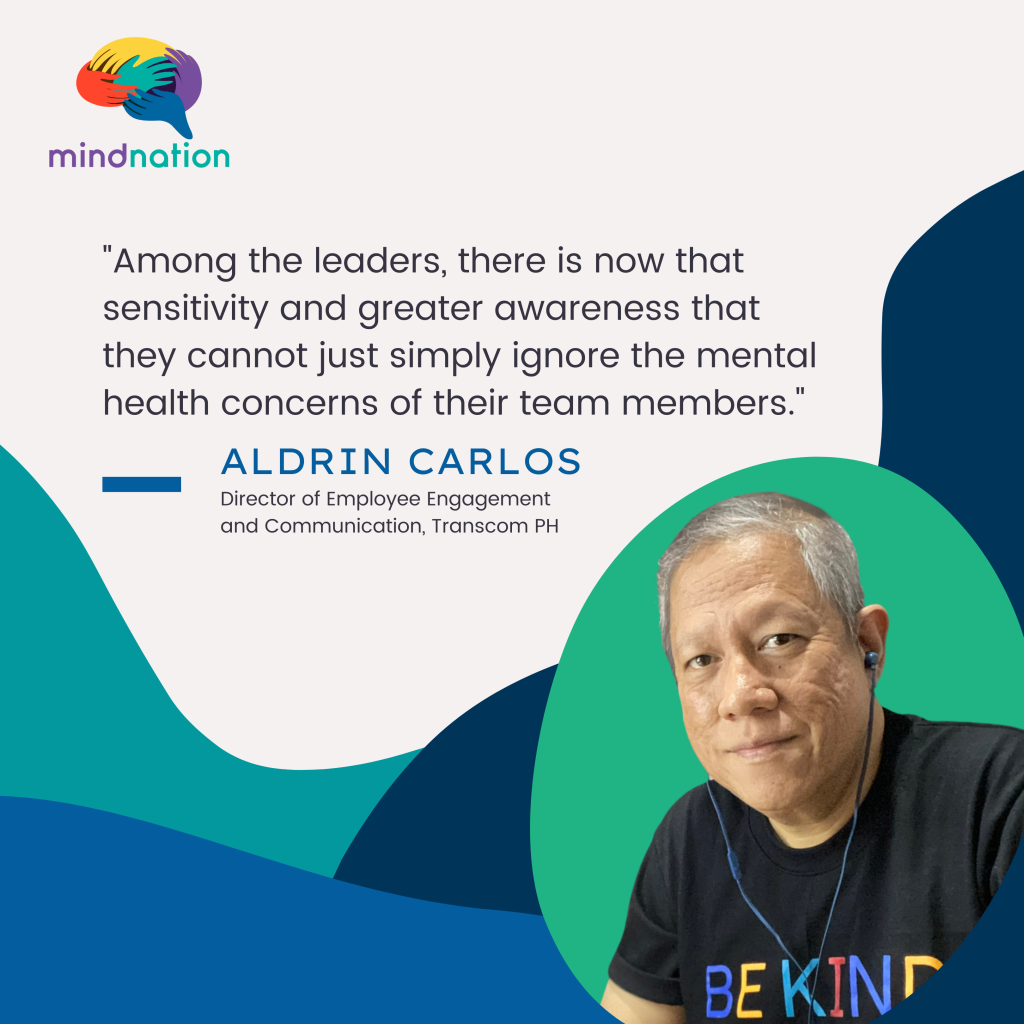
ALDRIN: Among the leaders, there is now that sensitivity and greater awareness that they cannot just simply ignore the mental health concerns of their team members. Additionally, there is a clamor from them on how they can be of assistance as far as mental well-being is concerned.

We were expecting the number of bookings for psychologist consultations to go down but recent months are actually showing spikes. This could either be a sign of a real concern, especially since the pandemic is far from over, or it could be because there is now more awareness among the employees that help is available and they might as well avail of it.  It was also observed that there are new hires who are availing of the services.

MindNation runs Weekly Energizer boosts through the Transcom Asia Facebook Page for employees that want to kick-start their week

Q: On a personal note, what have YOU been doing to take care of your mental well-being? 

ALDRIN: I am able to draw mental fortitude and resilience so far from my faith, from being grateful for the blessings and gifts I have received despite the ongoing situation, from my family, friends, and my team. There’ve been a lot of stressors but so far I have managed to not allow myself to succumb to them. I am very conscious not to allow myself to be affected by negative thoughts.

I do have projects at home that are stress-relievers and give me some sense of fulfillment – minor repairs that require some creativity, construction of an additional nook in the house, etc. I am also lucky that my work allows me to be creative and use my talents.

There are good movies via online subscription – old and new – that I watch and enjoy with my wife and kid and there are, once in a while, books published by my own friends which bring a sense of pride, joy, and inspiration.

Gratitude also allows me to help others and helping others is so rewarding and beneficial to mental health.

Q: What is the one mental health advice or practice that you take to heart, and why? 

ALDRIN: To never let myself be overpowered by a concern or a problem because I am bigger than my problem, and if the problem proves to be much bigger, I have a loving family and supportive friends who will back me up. And if the problem is so huge, there is a Bigger Being that takes care of me and loves me unconditionally. Help is always available in ways human and divine.

Q: What is your advice to colleagues in the industry who are also considering mental health programs in the workforce? 

ALDRIN: A mental health program, more than just a good people investment, is a concrete manifestation of genuine care to employees and their overall well-being. Go for it.

Q: What is the company looking forward to with regards to mental health and well-being this 2021?

As we continue to support our employees in any way we can, we are also looking for ways to extend our program to their loved ones. We are grateful to our employees’ families and whenever possible, we want to integrate them in the benefits we offer.

If you want to create a mental health program for your organization, you can partner with MindNation and email [email protected].

Categories
Fitness

9 Common Exercise Excuses That You Need To Stop Making

We all know that exercise is good for us, but if the weather is too hot or you just ended a day of back-to-back Zoom meetings, coupled with homeschooling, it’s easier to just put off working out in favor of plopping down in front of the TV. 

How can we help ourselves get moving? We asked Juancho Triviño, fitness advocate and founder of Fit Crew PH, an online personal training service, to bust the most common exercise excuses and his solutions for them.

“If you can spare 15 to 20 minutes scrolling through social media, then you have time to exercise.”

Juancho Triviño, fitness advocate and founder of Fit Crew PH

1. “I’m too tired, I just want to relax.”
First of all, if you are tired because you are sick, then do take time to rest and recover.

But if you are tired because of poor sleep, work fatigue, or mental health conditions, exercise can make you feel better. Start off with light exercises that are easy on the body but are just as effective, such as yoga and walking.  

Finally, if you are tired because you have a stressful job or are swamped with chores at home, change your routine. Instead of scheduling your workout at the end of the day when your energy is at its lowest, wake up earlier than usual to exercise, or do it on your lunch break. 

2. “I don’t have the time.”

“If you can spare 15 to 20 minutes scrolling through social media, then you have time to exercise,” says Juancho. “Just waking up extra early in the morning to squeeze in 15 to 20 minutes of light exercises or stretching can already prep your body and mind for all the rigorous things you need to do for the day.” 

3. “It costs too much.” 

While hiring a personal trainer is recommended for proper guidance, it is not mandatory. “You can follow free workout videos that are available online, or even ask for help from family or friends who are active,” Juancho advises. No equipment? Creativity goes a long way.

“Use water bottles or canned goods as weights; sturdy chairs can be used if you need elevation. Lastly, bodyweight exercises like push-ups, sit-ups, and squats can also be very effective for building strength.”


4. “I don’t like to exercise alone.”

There are benefits to exercising by yourself — you can go at your own pace and focus on doing the exercises correctly and efficiently. That said, there are also benefits to exercising with a group , including positive peer pressure and increased motivation. 

If you prefer to workout with others but the gyms in your area are still closed, there are many platforms online with live classes that you and your friends can join, such as Fit Crew PH. But if you’re struggling to put a group together, you can still work out by yourself without feeling like you are alone. “Personally, I like listening to music or podcasts while working out,” suggests Juancho. “It makes me feel like I am talking to someone.”

5. “It’s boring!”

There are so many different kinds of exercises out there — from swimming to spinning — that the key is to find something, anything, that gets your body in motion and puts a smile on your face. So if you find yourself bored or plateaued with a particular workout, switch it up. If yoga no longer interests you, try rowing; if you find boxing “Bleh,” try biking. “I’d much rather go three hours on a bike than 30 minutes on a treadmill,” admits Juancho. “Once you find something you enjoy doing, it won’t feel like an exercise.”

6. “I’m too old/too fat/not strong enough/etc. — the trainer will just laugh at me.”

“That will absolutely never happen,” Juancho stresses. “Coaches and trainers are professionals who work with a variety of fitness levels and will never judge someone based on their physical stature. In fact, we even feel happy if we see people trying to be the best version of themselves.” 

That said, this does not mean that you should plunge into whatever workout tickles your fancy. “Whether you are young or old, fit or unfit, always get clearance from your doctor before first starting a new exercise regimen,” advises Juancho.

7. “I tried exercising before and it didn’t work.”

There are many reasons why you’re not seeing results from working out. 

  • Maybe you weren’t consistent with exercising? It’s important to keep a routine and stick to it.
  • Maybe you were expecting too much, too soon? It may take anywhere from four to eight weeks of consistent workouts before you see a noticeable change.
  • Finally, maybe you relied purely on exercising? “Fitness also depends on what you eat and how you sleep,” Juancho points out. 

So analyze why the exercise didn’t work, and ask yourself what would have improved the chances of a positive outcome? Now make a plan with this newfound knowledge and start again.


8. “I’ll start tomorrow/next week/etc.”
If you are battling low motivation, you just have to do it. Start small so you don’t get daunted or discouraged. Instead of saying you will do 10 push-ups every morning, start with just two, then gradually increase the reps. Instead of aiming to exercise for an hour, try 40 minutes first, which when you think about it, is about the length of time of an episode of your favorite sitcom so it’s not that long. 

9. “I don’t need to exercise, I’m still young.”

“You’ll age quicker if you don’t take care of yourself,” Juancho warns. “Health is wealth, so as early as now, you have to invest in yourself, in the things that you want, and how you spend your time. Getting your body engaged and feeling aware of your physical state is a good start to a long and healthy life.”

When it comes to exercising, the gains outweigh the pains and excuses. A regular exercise routine will give you improved physical and mental health and can set your mood for the day. Best of all, it’s never too late to start. “There are many things that you will never regret doing, and exercise is one of them,” says Juancho.

For those in the Philippines, MindNation WellBeing Coaches are available 24/7 to help you build better physical and mental health habits. Book a slot now through FB Messenger http://mn-chat or email [email protected].

For more information about Fit Crew PH, message them on Instagram @fitcrew_ph.

Categories
How To

6 Tips For Handling Toxic Family Members

While arguments and disagreements between family members are normal, it’s important to distinguish between normal fights and toxic behavior.

“A relationship is toxic when it is not harmonious, when negative moments outweigh the positive ones,” explains Aiza Tabayoyong, a family and relationship expert from the Love Institute, a pioneering company equipping couples, parents, and individuals with skills on how to have fulfilling relationships with those dearest to them. 

The fights do not even have to be direct or explosive confrontations to be considered toxic. “The hurting can come in many forms,” points out Aiza. “It can be verbal abuse in the form of sarcasm, some subtle teasing, or giving the other person the silent treatment. 

It can even be passive-aggressive behaviors — like leaving the soap dish full of water knowing you’re the next one to use the soap, or finishing up all the food when they know it’s your favorite. At first glance, these behaviors are simply annoying.  But if  they occur constantly and the person does not change their ways even if you ask them to, they become hurtful and disrespectful, which leads to repressed anger, and becoming toxic.”   

Toxic relationships are bad not only for the relationship but also for the mental, emotional, and physical health of the people involved. “In a toxic relationship, your body and brain are constantly in a fight or flight mode because of so much stress,” explains Aiza. 

“In the long-term, this negative energy will literally become toxic in your system, and can also lead to different mental health challenges like depression or anger management issues,” she adds. 

“The fights do not even have to be direct or explosive confrontations to be considered toxic. The hurting can come in many forms. It can be verbal abuse in the form of sarcasm, some subtle teasing, or giving the other person the silent treatment.” 

 Aiza Tabayoyong, family and relationship expert from the Love Institute

How to move forward

Repairing a toxic relationship takes time, patience, and diligence. This is because most toxic relationships often occur as a result of longstanding and unresolved issues in the current relationship, or as a result of unaddressed issues from prior relationships. 

If you truly want the situation with your family member to change for the better, there are some things you can do to turn things around:
 

  1. Stay away from the source of the toxicity as much as you can. This can be hard to do these days when you are isolated at home with the other person and cannot literally go away, so it would help if you have a room of your own where you can take a breath. If not, Aiza recommends putting up some form of psycho-emotional shield, such as meditating, listening to music, praying, and also reminding yourself that you are distinct and different from the other person. 

“It’s important to cut the emotional connections especially if the other person knows your buttons,” she advises. “Instead of thinking ‘ There’s something going on with my loved one and it’s affecting me,’ shift the mindset to ‘There’s something going on with my loved one, I need to move away from striking distance so I will not be affected.’”

  1. Regroup and recollect. Once you’ve had your space and are in a better place, know your options. According to Aiza, there are three:

Option A: Are you going to accept the person’s behavior and just choose to live with it? The downside is you will need to set very firm boundaries to cope with the toxic behaviors, and the boundaries may become so rigid that you will be permanently disconnected from the other person.

Option B: Will you give hints and hope that the other person will get that you are affected by his or her particular behavior? In this case, be prepared for the possibility that they will never get it.

Option C: Ask for a dialogue with the other person. “Approach the other person with a sense of compassion, because he or she might be going through something that you are not aware of,” instructs Aiza. “Then use ‘I’ statements to convey how you feel, such as ‘I feel __ when you do __.’ This way, you are letting them know the effect of their behavior — not their personality or their character — on you. They won’t feel attacked, and the chances of them being defensive or angry will be minimized.” 

On the other hand, lashing out with “You’re so inconsiderate!” or “You always/never think of others,” is exhibiting judgement and will make the other person want to prove you wrong. He or she will lash back with, “That’s not true, I am very considerate, do you know how much I do for this family, etc. etc.”

  1. Talk to a professional. “Talking to a psychologist can provide you with a sounding board to process your feelings or help you view things from another perspective,” says Aiza.  
Photo by Liza Summer on Pexels.com

Dealing with toxic family members who are older than you

It’s easier to have difficult conversations with peers — like siblings or your partner —  than with older members of the family like parents or the parents in-law.  What should be done if they are the ones exhibiting toxic behavior? 

  1. At the very least, try to make the relationship civil. If the relationship has been sour for so long already, you cannot expect the other person to be as empathetic or compassionate to your pleas. “Bring the relationship first to neutral ground by knowing the other person’s love language, something that will build favor and allow you to reconnect,” shares Aiza.
  2. Present your case in a way that it’s beneficial for both parties. “Start by saying ‘I know it has been difficult for both of us; I’m sorry if I knowingly or unknowingly offended you or hurt you. I want to improve things around the house or our relationship, may I talk about it when you are available?’” suggests Aiza. “If they are ready, they will say yes. If they are not ready and say no, at least you tried.”
  3. In the case of in-laws, ask for help from your partner/their child. “Ask your partner to mediate and make things better, or bring you up in a better light,” she says.

How to reduce being toxic towards others

Because we are human, it’s highly possible that we are treating family members unpleasantly without even realizing it. How can we become less toxic people ourselves?

  1. Get feedback. “Ask trusted people whom you know will not hurt you for feedback. For parents, if you have a good enough sense of your self-worth, ask your kids ‘How is mommy doing? Is there anything you would like me to do so I can be a better mom?’” suggests Aiza. 
  1. If there is no one to ask, just be observant of yourself. “What is your own level of stress that you may be bringing into your relationships. How happy are you with your life? How contented are you?” Aiza asks. 

If you prefer a  scientific approach, MindNation has an online WellBeing Quiz that you can take for free to check on your mental status and happiness level. If you score Healthy or Thriving, then you are in good shape and no one is affected by you; but if you are Fading or Burned Out and you realize that there are people you rub the wrong way or people who trigger you, you might want to step back and see where that’s coming from. 

“Is it because you’re tired? Or maybe you have some unresolved issues that need to be resolved?” asks Aiza. “Whatever it is, you might want to work on those now, because a lot of our past issues manifest either in relationships or at work.”

  1. Make time for self-care. “This is very, very important, especially if there are other people counting on you,” Aiza stresses. “Self-care is whatever it looks like for you, whether it’s doing breathwork, meditating, walking under the sun (just make sure to stay safe), bingeing a little bit of tv, or talking to your friends and finding a reason to really belly laugh.” 

For Aiza, the COVID-19 pandemic is a unique opportunity for the family to work on their issues and become stronger. “Think of it as a forced team building exercise,” Aiza says. “Now is the perfect time to look at any problems that you may have, take a pause, and deliberately work on them.”

MindNation psychologists and WellBeing Coaches are available 24/7 for teletherapy sessions if you need help addressing relationship issues, past traumas, or to work on yourself. Book a slot now through FB Messenger or email [email protected].

Categories
Self Help

8 Ways To Overcome Impostor Syndrome

Academy Award-winning actor Tom Hanks struggles with it. So do Facebook COO Sheryl Sandberg, tennis superstar Serena Williams, and Nobel Prize-winning poet Maya Angelou. We are talking about imposter syndrome, defined as an internal experience of believing that you are not as competent as others perceive you to be. 

“Imposter syndrome is the experience of feeling like a fraud despite your successes,” says psychologist Riyan Portuguez.  “You think you only got to where you are because of luck, and that any moment someone will expose you for being inadequate or incompetent.”

While imposter syndrome usually appears in high achievers, it can affect anyone no matter their social status, work background, skill level, or degree of expertise.

Some of the common signs of imposter syndrome include:

  • Self-doubt
  • Attributing your success to external factors like good luck or good timing
  • Fear of failure or committing mistakes
  • Fear that you won’t live up to expectations
  • Fear of being judged by others

“Imposter syndrome is the experience of feeling like a fraud despite your successes.You think you only got to where you are because of luck, and that any moment someone will expose you for being inadequate or incompetent.”

Psychologist Riyan Portuguez

Causes

Certain factors can contribute to the experience of impostor syndrome. These include:

  • Family dynamics: Family expectations and the value of success and perfection in childhood can stay with an individual throughout their life.
  • Cultural expectations: Different cultures put different values on education, career, and different definitions of success.
  • Individual personality traits: Perfectionism can lead to imposter syndrome.

Imposter syndrome vs. humility
Imposter syndrome is oftentimes mistaken for excessive humility. But being humble does not mean having a poor opinion of yourself. Instead, you accept yourself and your many good qualities, as well as your limitations. 

People with imposter syndrome, on the other hand, will beat themselves up for committing mistakes and constantly ruminate on what they did wrong or how they could have done better. “Imposter syndrome results in impairment and missed opportunities,” Riyan points out. “When a promotion is offered, for example, a humble person will accept it graciously, acknowledge that they will encounter challenges, and ask for help when needed. On the other hand, someone with imposter syndrome will reject the promotion just because they feel they do not deserve it.” 

How to overcome it

While imposter syndrome is not a recognized mental disorder, it can contribute to mental health challenges like anxiety and depression. So if you see yourself exhibiting characteristics of imposter syndrome, you need to do something about it right away:

  1. Own your successes. “Credit yourself for your achievements and always remind yourself that you deserve the recognition you get,” says Riyan.
  1. Temper your perfectionist tendencies. Instead, learn how to set goals that are challenging but at the same time realistic and achievable.
  2. Accept that mistakes are a part of life. “No one is perfect; there is always room for growth,” reminds Riyan. “Treat mistakes as opportunities for you to become a better version of who you are.”
  3. Be comfortable with discomfort. Navigate your feelings, even the uncomfortable ones. Whenever you experience feelings of self-doubt or inadequacy, ask yourself why you are feeling this way and what made you feel this way. “By doing this, you will eventually identify your triggers and find ways to control them,” Riyan explains.
  4. Repeat after yourself: “Feelings are not facts.” Just because you feel unqualified does not mean you are unqualified. Be aware of the automatic defeatist thoughts and feelings you have, and work on countering those with reality-based statements, such as, “I am qualified for this task because….”
  5. Stop comparing yourself to others. “You are unique in your own way, you move at your own pace,” says Riyan. “If there is something that you need to compare yourself to, it’s to who you were before.”
  6. Use social media moderately. Spending too much time on social media can cause feelings of inferiority and will only make your feelings of being a fraud worse.
  7. Talk to your trusted friends and loved ones. Irrational beliefs tend to fester when they are hidden and not talked about, so the more you talk about it with someone, the more you realize what the problem is and that you are not the only one struggling. Loved ones can also give you the confidence boost you need to overcome your self-doubt. 

While experiencing imposter syndrome is normal, you don’t have to let it control your life and stop you from achieving your goals. Overcome your perfectionist tendencies by setting realistic goals for yourself, and accept that mistakes and failures are a part of life. Whenever you start to doubt your own skills, talk to others so that you realize your fears are unfounded. Finally, take ownership of your successes. Learn how to accept compliments, and draw strength from it.

MindNation psychologists and WellBeing Coaches are available for 24/7 teletherapy sessions if you need someone to talk to about your fears and insecurities. Book a slot through FB Messenger http://mn-chat or email [email protected]

Categories
Featured

Beyond Fasting: 5 Lessons We Can All Learn From Ramadan

Today marks the end of Ramadan, the holiest month in the Islamic calendar. One of the key obligations of Ramadan –and the one most familiar to non-Muslims — is fasting. For 29 to 30 days (depending on the lunar cycle), Muslims abstain from eating and drinking during daylight hours. They begin their fast at dawn – usually by eating a light meal known as Suhur – and end it once the sun has set with a meal known as Iftar. Not everyone has to fast — children, the elderly with medical conditions, those who are sick, and pregnant and breastfeeding women are exempted from fasting. Women can also break their fast during Ramadan if they are menstruating; they and any others who miss a few days of fasting for whatever reason can then “make up” for the missed days when the month is over. 

But the fasting is not limited to food and drinks. “We also fast from unhealthy habits and bad behavior,” explains Neiveen Essam, MindNation’s Marketing Manager for the Middle East and North Africa. “These include smoking, swearing, gossipping, arguing, bullying, fighting, or being disrespectful, cruel or selfish.”

This just goes to show that the month of Ramadan is more than just depriving oneself of physical indulgences. Below is what Ramadan is actually about, and what we — regardless of our religious views — can learn from it.

“We use the time to reflect and improve ourselves… By doing this, we realize where we are and where we want to be.” 

Neiveen Essam, MindNation’s Marketing Manager for the Middle East and North Africa
  1. It is a time of introspection.
    Ramadan essentially pushes people to slow down from their fast-paced lives and recalibrate. “We use the time to reflect and improve ourselves,” says Neiveen. “We ask ourselves questions like ‘Do I like where I am in my life? What’s gone well over this past year? What more can I do? And what can I do less?’ By doing this, we realize where we are and where we want to be.” 

What non-Muslims can do: Every so often, take a break from your regular routine and reflect on your life. Think about where you are now, what you’re doing, and your habits. Are you happy and content? If not, what can you do about it?

  1. It teaches empathy.
    By going without food and water for an extended period of time, Mulims realize what it must be like for many people all over the world who experience hunger and thirst on a daily basis. “We learn to be more compassionate towards the less fortunate,” says Neiveen. 

What non-Muslims can do: Develop a habit of gratitude. Take a few moments each day to consider at least three things you are grateful for. You can record them in a journal, or just allow them to absorb your thoughts.

  1. It reminds us to be generous.
    Iftar before the COVID-19 pandemic was a festive time of day.  Communities and organizations would prepare tables laden with food and set up chairs in public places so that anyone and everyone — most especially the needy — can eat for free. This year, such gatherings are banned because of social distancing measures, although most people continue the tradition on their own by ordering small Iftar meals from restaurants and distributing them to poor neighborhoods.

    What non-Muslims can do: There are many ways to safely do charity work during the pandemic. If you want to serve in person, speak with your local churches or community groups to find out what opportunities are available; if you prefer to stay at home, gather and/or donate much-needed supplies to organizations in need.
  2. It brings people closer together.
    “Traditionally, people take Ramadan as an opportunity to meet and socialize, especially if they do not meet a lot throughout the year,” explains Neiveen. Families and friends share Iftar or Suhur in each other’s homes, with some even going to more than one home in the span of an evening. But because social gatherings are banned this year, many are connecting with their loved ones through digital platforms instead. 

What non-Muslims can do: Video chatting is great, but if you want to make your weekly calls with family and friends more special, try hosting a game night just to spice things up. There are many options available online, from simple trivia games to classic board games that got virtual makeovers. 

  1. It boosts your spiritual well-being.
    Fasting from bad behavior, reflecting, and being charitable are all ways we can find meaning in our lives and become more motivated to become better people. “It is very easy for God to just tell us to donate to the poor,” Neiveen says. “But by telling us to fast, He lets us really feel what the less fortunate are feeling so that when we DO donate, it is more sincere and impactful.”  

    What non-Muslims can do: Find your Ikigai —  what is your reason for getting out of bed each morning? Answering this question will lead you down a road where you will think more in-depth about yourself and allow you to notice things about yourself that will help you achieve fulfillment.  Read more about Ikigai here

Even though Ramadan only lasts a month, it is possible to carry its lessons throughout the year. “Once you learn the lessons, be consistent,” Neiveen advises. “Always remind yourself that not only can you be a good person, you can be a better person by continually practicing good habits and abstaining from  bad ones.”

24/7 teletherapy sessions with psychologists and WellBeing Coaches are available for those living in the United Arab Emirates. Message bit.ly/mn-chat to book a session now. Sessions for the rest of the Middle East and North Africa coming soon!

Categories
Mental Health 101

What is Gaslighting?

In 2018, Oxford Dictionaries named “gaslighting” as one of the most popular words of the year. It is defined as the act of undermining another person’s reality by denying facts, the environment around them, or their feelings.

Struggling with relationship problems? MindNation psychologists and WellBeing Coaches are available 24/7 for teletherapy sessions in the Philippines if you need someone to talk to. Book your session now through bit.ly/mn-chat or email [email protected]

“Gaslighting is a form of manipulation,” says psychologist Riyan Portuguez. “A person who gaslights seeks to gain more power in an argument by portraying themselves as the victim or making the partner question their worth.” 

Common statements you may hear from gaslighters include: 

“I was just joking.”

“I didn’t do that/I never said that. You’re imagining things.”

“You have issues.”

“You’re upset over nothing.”

“Here we go again.”

“You’re being sensitive/you’re so dramatic.”

“Gaslighting can be unintentional, especially in cases where one person is so afraid of losing the other that they will say anything to divert blame or avoid a difficult conversation,”

Riyan Portuguez, psychologist

While gaslighting is most often mentioned in the context of a romantic relationship, any relationship that has a power dynamic (i.e. friends, family members, or workmates) can be a breeding ground for this toxic behavior. This means that not only is it highly likely that most of us have been gaslighted at some point in our lives, it’s also possible that we have inadvertently gaslighted other people as well. 

“Gaslighting can be unintentional, especially in cases where one person is so afraid of losing the other that they will say anything to divert blame or avoid a difficult conversation,” explains Riyan. “But we need to understand that gaslighting is self-defeating, because it does not resolve the conflict in a mature or proper way.” 

Gaslighting can have a devastating and long-term impact on our emotional, psychological, and even physical well-being. This is why it’s important to learn how to spot the technique, shut it down, and minimize the psychological impact on our daily lives or the lives of our loved ones.

How to tell if you are being gaslighted

According to Dr. Robert Stern, author of the book “The Gaslight Effect: How to Spot and Survive the Hidden Manipulation Others Use to Control Your Life,” signs that you are a victim of gaslighting include:

  • No longer feeling like the person you used to be
  • Being more anxious and less confident than you used to be
  • Often wondering if you’re being too sensitive
  • Feeling like everything you do is wrong
  • Always thinking it’s your fault when things go wrong
  • Apologizing often
  • Often questioning whether your response to your partner is appropriate (e.g., wondering if you were too unreasonable or not loving enough)
  • Making excuses for your partner’s behavior

What to do if you feel you are being gaslighted

  1. Don’t say “You’re gaslighting me!” “Accusations will only make the other person defensive and escalate the situation. Remember that it’s possible your partner is not even aware that they are gaslighting,” reminds Riyan.
  2. Instead, point to specific, observable actions and how they made you feel. Use ‘I’ statements such as “I felt __ when you did/said ___.”
  3. When presenting your side, stand your ground. “Gaslighters will seek to confuse you. But if you know your truth, it won’t be as easy to sway you,” Riyan says.
  4. Always remember that you are not responsible for another person’s actions or emotions. Gaslighters usually claim that you provoked the abuse. “Most victims of gaslighting end up rationalizing the gaslighter’s behavior by saying ‘He reacted this way because I did this’ or ‘It’s my fault she said that.’ But if we start feeling responsible, it will be hard for us to recognize reality,” Riyan shares. “It’s good to be empathetic and try to look at the other person’s point of view, but if you are the one wronged, you need to put up healthy barriers.”   
  5. Talk to someone about what you are going through. These can be trusted friends, loved ones, or even a mental health professional. This does not mean telling them off the bat that the other person is a gaslighter. “Don’t seek to make the other person look bad because again, they might not even be aware of what they are doing,” cautions Riyan. Instead, focus on the problem or the situation and seek advice on what to do, or if your thoughts and feelings are valid.
  6. Know when to walk away. “If you have exhausted all means but the gaslighter refuses to change their ways, then you need to leave the relationship to protect your mental health and peace of mind,” advises Riyan. “You are not responsible for changing another person; better to spend your time and energy with people who are more deserving of your attention and who see your worth.”

How to stop yourself from gaslighting others

If you are worried that you might be gaslighting your loved one, here are things you can do:

  1. Think before you speak or act. “Before you say or do something during a difficult conversation, ask yourself if your words or actions will improve the relationship, or worsen it,” advises Riyan.
  2. Seek to find common ground, not to “win.” “What is more important to you, the relationship, or your need to be right?” asks Riyan.
  3. If you made a mistake, own up to it. “Nobody is perfect, so reevaluate yourself before you plunge into a difficult conversation,” Riyan suggests.
  4. If the other person really misread the situation or misjudged you, don’t get angry or defensive. “This can happen in partners who came from toxic or abusive relationships; they inadvertently bring their hurts and insecurities into their current situation,” explains Riyan. So instead of responding to their accusations with “You’re being dramatic, it’s nothing!” or “You’re just imagining things,” ask them to pinpoint what exactly you did or said that they found wrong, and explain your side. “Don’t avoid the conversation; use it to give your partner the reassurance that they need,” she adds.

It is entirely possible to stop gaslighting behavior, but it will take a great deal of self-awareness to do so. While there are some who are able to do it on their own, talking to a mental health professional can also help. Therapists can guide you in examining your actions and see if you have been, consciously or unconsciously, engaging in toxic behaviors. They can also help you to make needed changes that will make your own life and relationships better.